Retail lighting design planning directly impacts whether clients accept your proposals or move to a competitor. The difference between a generic bid and one that wins comes down to how well you present the lighting strategy, the numbers behind it, and the real value it delivers.
At OpenLumen, we’ve seen contractors land bigger projects and higher margins by treating lighting proposals as a complete business case, not just a product list. This guide walks you through the elements that make proposals stand out and get approved.
Why Lighting Strategy Wins Retail Proposals
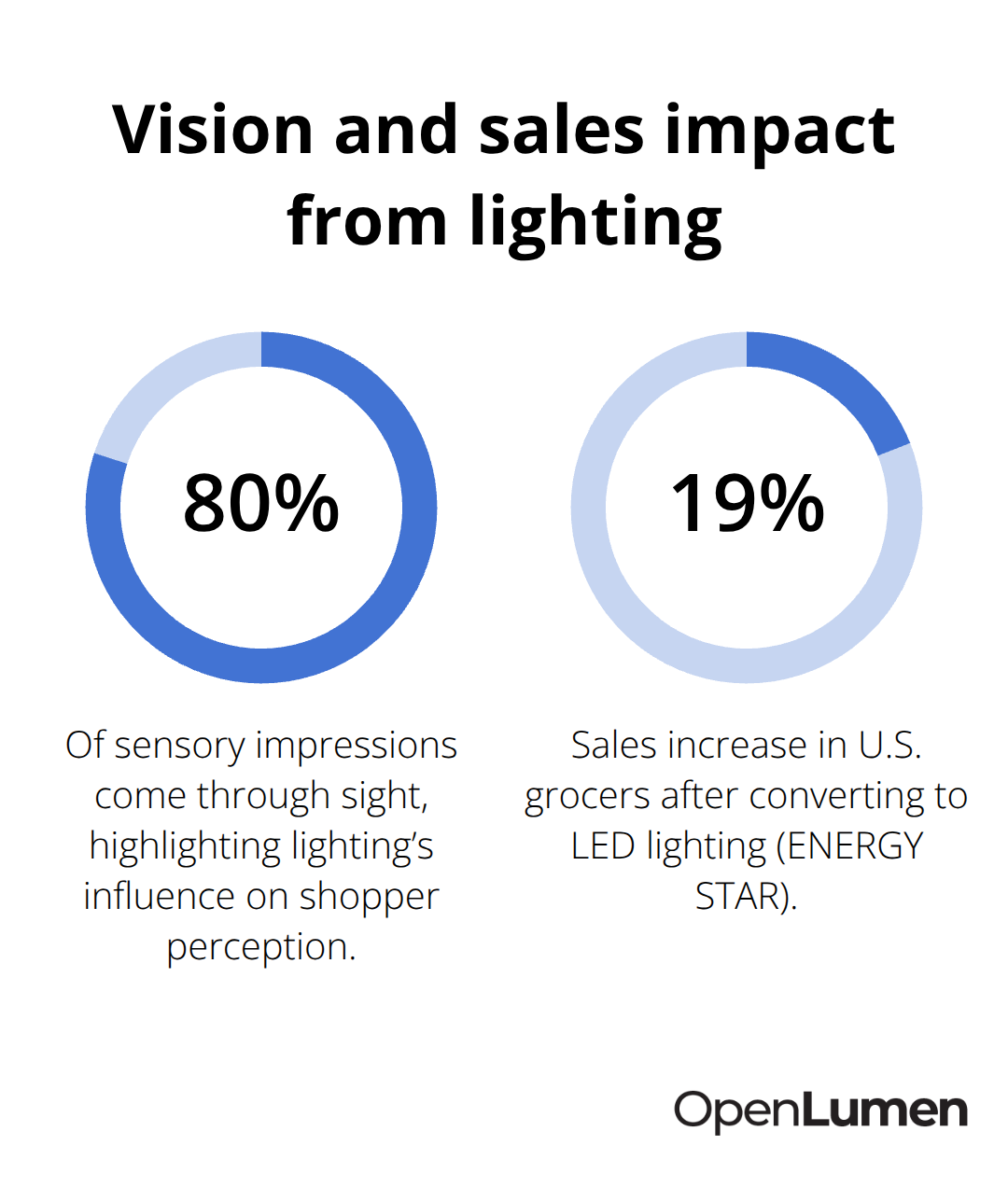
Clients don’t buy lighting fixtures-they buy the promise of higher sales, lower energy bills, and a store that feels right to customers. This is why your proposal needs to lead with business outcomes, not product specs. Research from the National Center for Biotechnology Information shows that roughly 80 percent of sensory impressions come through sight, which means lighting directly shapes how shoppers perceive your client’s brand and merchandise. ENERGY STAR reported that converting U.S. grocers to LED lighting increased sales by about 19 percent. These numbers matter because they shift the conversation from cost to return on investment.
When you present a proposal with concrete sales uplift data and energy savings projections, you compete on value rather than price. Clients see the difference between a contractor who understands retail psychology and one who just installs lights.
The Sales Impact Clients Actually Care About
A well-designed lighting plan illuminates a space while it guides customer attention, extends dwell time, and influences purchase decisions. High color rendering (CRI 90 or higher) makes clothing, cosmetics, and fresh food look appealing and true-to-color, which directly boosts purchase intent. Accent lighting that highlights key merchandise creates visual focal points that pull customers deeper into the store. Soft, flattering lighting in dressing rooms can lift conversion rates from around 10 percent to 67 percent-a figure that makes clients sit up and listen. When your proposal quantifies these effects with real numbers and explains exactly how your fixture selection, color temperature choices, and layering strategy will deliver them, you move beyond generic bidding into consultative selling.
Standing Out Against Generic Competitors
Most contractors submit proposals that look identical: a list of fixtures, wattages, and installation costs. Your competitors probably do this too. The proposals that win include photometric analysis showing illuminance levels across the floor plan, color rendering metrics matched to product categories, and energy consumption comparisons that prove long-term savings. Presenting 3D renderings or lighting simulation images helps clients visualize the finished space before construction starts. A maintenance and control strategy-like smart dimming schedules or occupancy sensors-shows you’ve thought beyond day one. When you address specific challenges like glare reduction in jewelry displays or skin-tone rendering in fitting rooms, you demonstrate expertise that generic bids simply cannot match. Clients recognize the difference and reward it with project approval and higher contract values.
How Photometric Data Strengthens Your Position
Photometric analysis transforms a proposal from a sales pitch into a technical document that clients trust. Illuminance maps reveal exactly how bright each zone becomes, whether you meet industry standards like IES RP-2-20 (which targets 20-40 fc on floors, 50 fc at display height, and 100-500 fc for special displays), and how your design compares to competitor bids. Color rendering data proves that your fixture choices will show products accurately under your proposed lighting. Energy modeling shows payback periods and annual savings, which turns an upfront cost into a long-term investment. When you include these metrics in your proposal, clients move from skepticism to confidence because they see the engineering behind your recommendations.
Building Lighting Designs That Win Client Approval
The difference between a proposal that gets rejected and one that gets approved comes down to three core decisions: how you layer light across different zones, what color temperature and rendering you specify, and how you demonstrate energy payback. These aren’t theoretical choices-they directly determine whether your client sees higher sales, lower operating costs, and a store that feels intentional rather than generic.
Zoning and Illuminance: The Foundation of Professional Proposals
Retail spaces demand specificity. A grocery store’s produce section needs different illuminance and color temperature than its fitting room. A jewelry counter requires higher color rendering than a stockroom. When you design with these distinctions in mind and explain them clearly in your proposal, clients recognize that you understand their business, not just lighting.
According to IES RP-2-20, ambient floor lighting should target 20 to 40 foot-candles, displays at height need about 50 foot-candles, and special displays can reach 100 to 500 foot-candles. These aren’t suggestions-they’re the baseline that separates professional proposals from amateur ones.
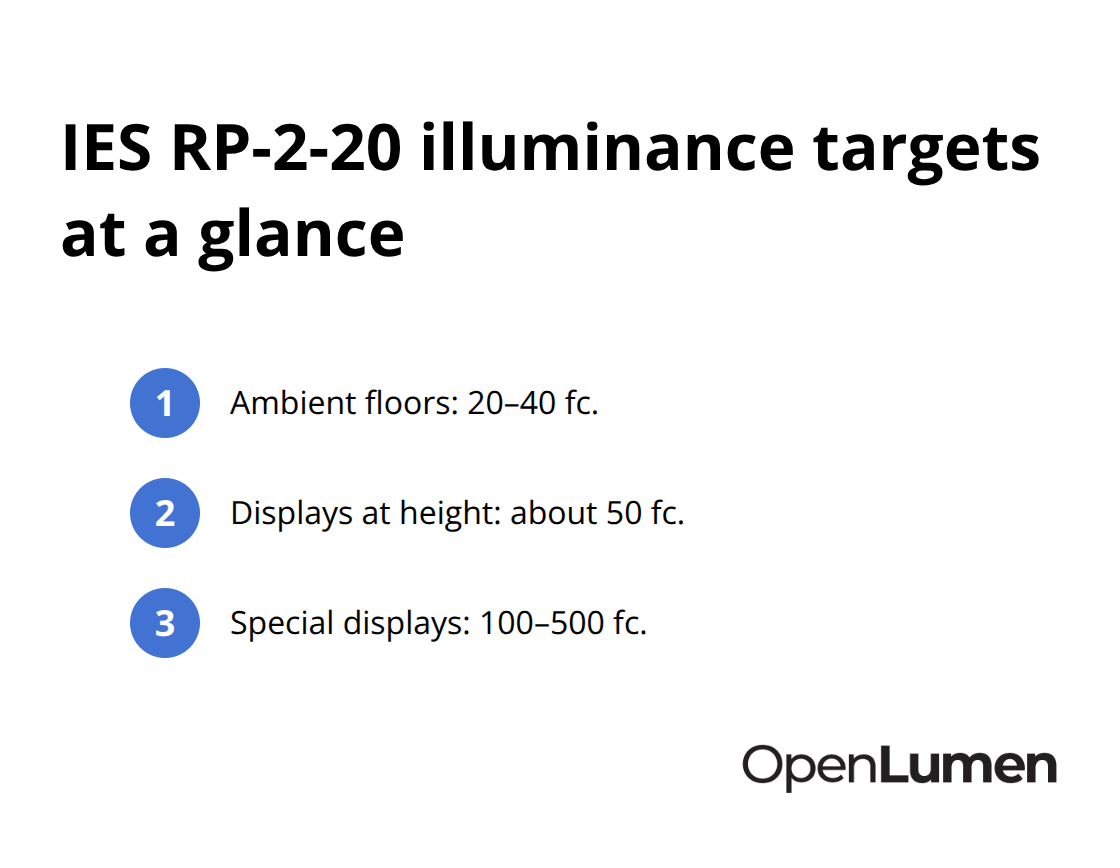
When you specify these illuminance levels for each zone in your proposal, clients see that you’ve engineered the space rather than guessed at it.
Layering Light for Control and Depth
Layering ambient, accent, and task lighting creates depth and controls attention without overwhelming the space. Ambient lighting provides general visibility and sets mood, typically using softer recessed downlights at 2700 to 3500K. Accent lighting, delivered through track fixtures or directional recessed units, highlights merchandise and creates visual hierarchy. Task lighting at checkout counters and service desks supports staff operations without interfering with the shopping atmosphere.
When you specify these three layers separately in your proposal with distinct fixture types and illuminance targets, clients understand that you’ve engineered the space. This approach also prevents the common mistake of over-illuminating areas where customers browse, which causes fatigue and shortens dwell time.
Color Temperature and Rendering: Making Products Look Their Best
Color temperature and rendering quality determine whether products look appealing or washed out. For most retail applications, 3000 to 3500K creates warmth without appearing artificial, which is why it remains the default for clothing, home goods, and general merchandise. However, dressing rooms and grocery stores benefit from slightly cooler 4000 to 4500K because it renders skin tones and produce more honestly, and shoppers make better purchasing decisions when they see products as they’ll appear at home.
Jewelry and high-end cosmetics justify pushing toward 5000K to maximize sparkle and perceived color fidelity. More importantly, try for CRI 90 or higher across all retail spaces-this ensures colors render accurately under your proposed lighting. When a client asks why you specified a particular CRI or color temperature, you should have a product-specific answer, not a generic one.
For dressing rooms specifically, soft diffused front-facing lighting with minimal glare can increase conversion rates from roughly 10 percent to 67 percent according to industry data. This number deserves prominent placement in any apparel retail proposal because it directly connects your lighting choices to measurable sales impact.
Energy Efficiency and Payback: Turning Cost Into Investment
LED fixtures with lifespans around 50,000 hours and smart controls reduce energy consumption by up to 50 percent compared to manual systems, which translates to real annual savings that justify upfront costs. When you calculate payback periods and present them alongside compliance with local electrical codes and IES standards, you transform energy efficiency from a nice-to-have into a business driver that clients cannot ignore.
Your proposal should specify fixture wattages, total system wattage, estimated annual energy cost, and projected savings within the first five years. These numbers give clients confidence that you’ve done the math and won’t leave them with unexpected operating costs. The next section covers how to present these calculations and photometric data in formats that clients actually understand and trust.
How to Present Lighting Data That Wins Approvals
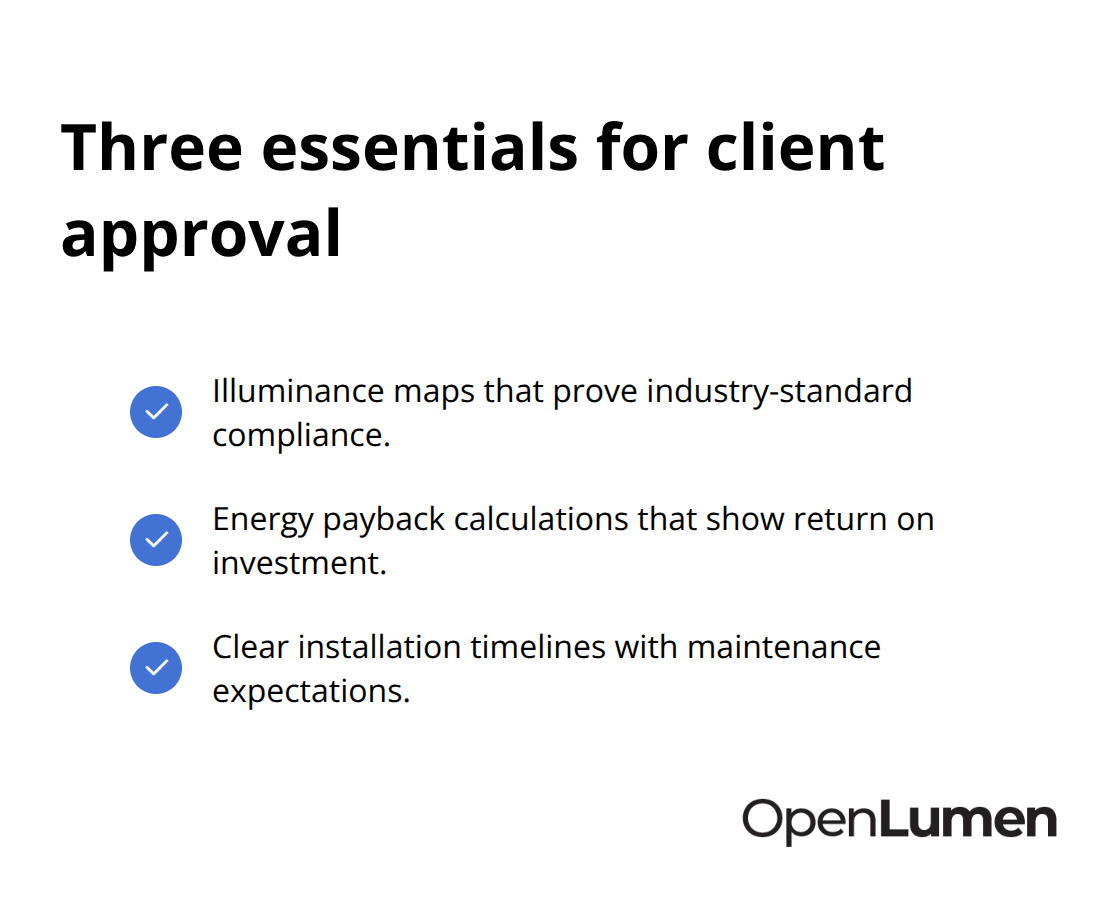
Clients approve proposals when they see three things: illuminance maps that prove your design meets industry standards, energy payback calculations that show return on investment, and clear installation timelines with maintenance expectations. Most contractors skip one or all three, which is why their proposals lose to competitors who deliver them.
Illuminance Maps and Photometric Analysis
Photometric analysis transforms your proposal from a subjective pitch into measurable proof. Illuminance maps show exactly where light lands on the floor and at display height, then overlay those maps with IES RP-2-20 targets to prove compliance. Include color rendering data by zone-this matters most for clothing, cosmetics, and produce where CRI 90 or higher directly influences purchase decisions. When you present these visuals alongside a rendering or 3D simulation, clients move from imagining the space to seeing it.
A browser-based platform like OpenLumen lets you create photometric layouts and run real-time illuminance analysis without expensive software, which means you can generate professional reports faster and adjust designs on the fly based on client feedback.
Energy Modeling and ROI Calculations
Energy modeling calculates total system wattage, annual operating cost under your design, and annual savings compared to the existing system or competitor bids. ENERGY STAR data showing 19 percent sales increases in converted grocery stores gives clients a concrete ROI anchor point, but your proposal must translate that into their specific space with their specific product mix. Include a simple payback table showing year-one savings, cumulative five-year savings, and the break-even point. Most clients approve projects with payback periods under three years, so if your design doesn’t hit that threshold, you need to either optimize the fixture selection or explain why premium quality justifies longer payback.
Installation Specifications and Maintenance Schedules
Installation and maintenance guidance separates proposals that get built from ones that sit on a shelf. Specify fixture types with exact model numbers, mounting heights, spacing, and beam angles so your client’s electrician has no ambiguity. Include a maintenance schedule covering lamp replacement intervals, lens cleaning frequency, and control system updates.
Smart controls deserve special attention because they extend the life of your proposal’s value-occupancy sensors reduce wasted lighting in stockrooms, daylight harvesting adjusts ambient levels to match natural light, and dimming schedules adapt to seasonal promotions without additional fixture changes. Clients appreciate knowing upfront that LED fixtures last around 50,000 hours compared to 2,000 hours for incandescent, which means maintenance costs drop significantly over time.
Long-Term Operational Cost Comparison
A maintenance cost comparison shows annual labor and replacement expenses under the old system versus the new one, and this often tips hesitant clients toward approval because it proves your design reduces their long-term operational burden. If your proposal includes a post-installation commissioning visit to verify illuminance levels match specifications and train staff on controls, clients recognize that you stand behind your work.
Final Thoughts
Strong retail lighting design planning separates contractors who win consistent work from those who compete on price alone. Clients approve projects when you present photometric data, energy payback calculations, and product-focused lighting strategies that demonstrate expertise rather than generic recommendations. The three core elements-illuminance maps that prove compliance with IES RP-2-20, color rendering specifications matched to merchandise categories, and maintenance guidance that reduces long-term operating costs-transform bids into consultative proposals that clients trust and fund at higher contract values.
Standardize your proposal approach by documenting the specific illuminance and color temperature targets for different retail categories: grocery produce, apparel fitting rooms, jewelry displays, and service counters all demand different specifications. Build a template that includes photometric analysis, energy modeling, and a maintenance schedule so you generate professional reports consistently without reinventing the process for each client. This consistency saves time and ensures you never miss a critical element that weakens your proposal.
OpenLumen is a free, browser-based platform that lets you create photometric layouts, run real-time illuminance analysis, and generate professional reports without expensive software. Its community-verified luminaires library and instant photometric metrics streamline the design-to-install workflow so you design, sell, and validate lighting faster. Lead your next retail project with business outcomes instead of product lists, back every claim with numbers, and watch clients stop comparing your proposal to competitors and start asking when you can begin installation.
The information provided is for general educational purposes only and should not be considered professional engineering or lighting design advice. Always verify project requirements, local codes, and specifications with qualified professionals before making final decisions.