Photometry handoffs go wrong more often than they should. Miscommunicated specs, missing files, and unclear expectations create delays that ripple through your entire project timeline.
At OpenLumen, we’ve seen firsthand how proper photometry handoff guidelines transform these transitions from chaotic to seamless. This guide walks you through the exact steps that work.
What Photometry Handoff Actually Means
A photometry handoff is the moment when photometric data moves from the luminaire manufacturer or testing lab to the designer, contractor, or facility owner who needs to use it. This isn’t just transferring a file. It’s transferring technical specifications, dimensional data, performance curves, and quality assurances that determine whether your lighting layout will actually work in the real world. The scope covers luminous intensity distributions, spectral data, stray-light corrections, physical dimensions, symmetry status, and file naming conventions. Without clarity on what moves and why, designs fail, installations don’t match specifications, and projects slip.
Who Participates in the Handoff
The stakeholders involved range from photometric labs conducting the measurements, manufacturers packaging the data, designers selecting and integrating luminaires into layouts, contractors installing the fixtures, and facility owners verifying performance. Each group has different priorities. A lab cares about measurement accuracy. A designer needs clean, symmetrical data in the right file format. A contractor needs physical dimensions to avoid clashes with ducts or structural elements. A facility owner wants to know the fixture will deliver the promised light output and energy efficiency. Misalignment between these groups creates the real pain points.
Where Handoffs Break Down Most Often
A large share of photometric data files encountered in practice are problematic, yet many design tools import them without built-in quality checks. Stray light and uplight in photometric data can appear at 4–6%, inflating reported lumen output and causing lumen-per-watt calculations used in building regulations to be too high. Missing or incorrect physical and luminous dimensions undermine luminaire layout accuracy and create safety clearance issues with other building services. Many data sets also lack symmetry (development prototype data are non-symmetric while product data should be symmetric, yet non-symmetric product data frequently reaches designers).
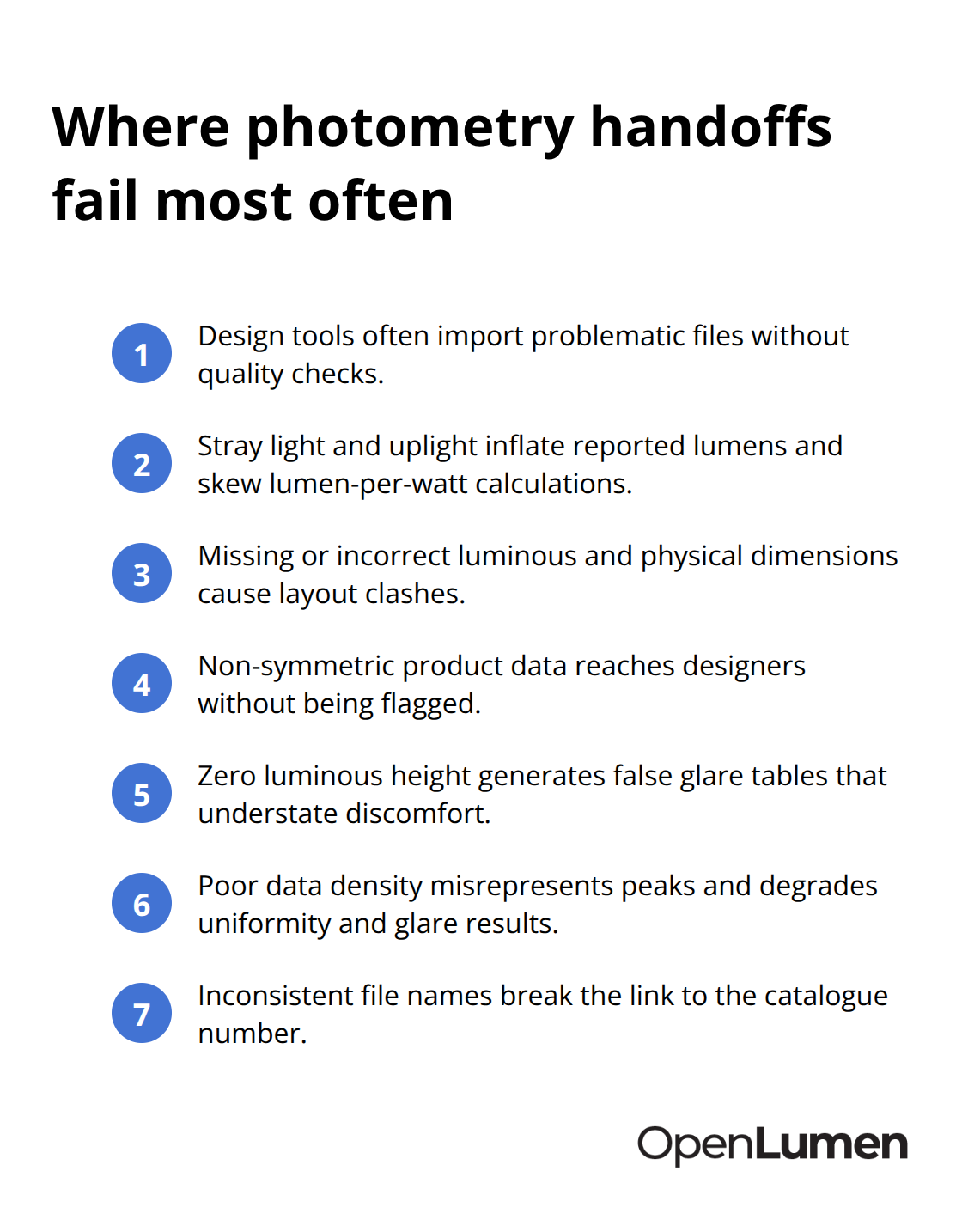
Luminous height of zero in all four planes produces false glare tables that underestimate visual discomfort. Data density problems range from excessive angular steps that slow calculations with little gain to insufficient steps that miss peaks in narrow-beam LED streetlights, degrading accuracy of uniformity and glare calculations. File naming inconsistencies cause designer confusion when the file name doesn’t clearly match the catalogue number. These aren’t edge cases. They happen in standard workflows and accumulate into significant project costs and delays.
The Real Cost of Poor Handoffs
When photometric data arrives incomplete or inaccurate, designers waste hours troubleshooting why their calculations don’t match field results. Contractors discover mid-installation that physical dimensions don’t match luminous dimensions, forcing layout revisions. Facility owners end up with lighting that doesn’t meet energy codes or performance targets because the underlying data was inflated. These failures compound quickly across multiple projects and teams.
What Needs to Change
The solution isn’t complex. It requires establishing what should move from one party to the next, verifying quality before transfer, and using standardized naming and documentation practices that every stakeholder understands. The next section outlines the exact documentation and data requirements that prevent these failures from happening in the first place.
Critical Documentation and Data Requirements
The handoff requires more than a single IES or LDT file. Labs must document stray-light corrections separately because uplight and scattered light routinely inflate lumen output by 4–6%, causing your lumen-per-watt calculations and building regulation compliance to rest on inflated numbers. Labs should perform extra stray-light readings to quantify and remove stray light from raw photometric data, then report the correction value explicitly so designers know whether the file they receive already accounts for it or not.
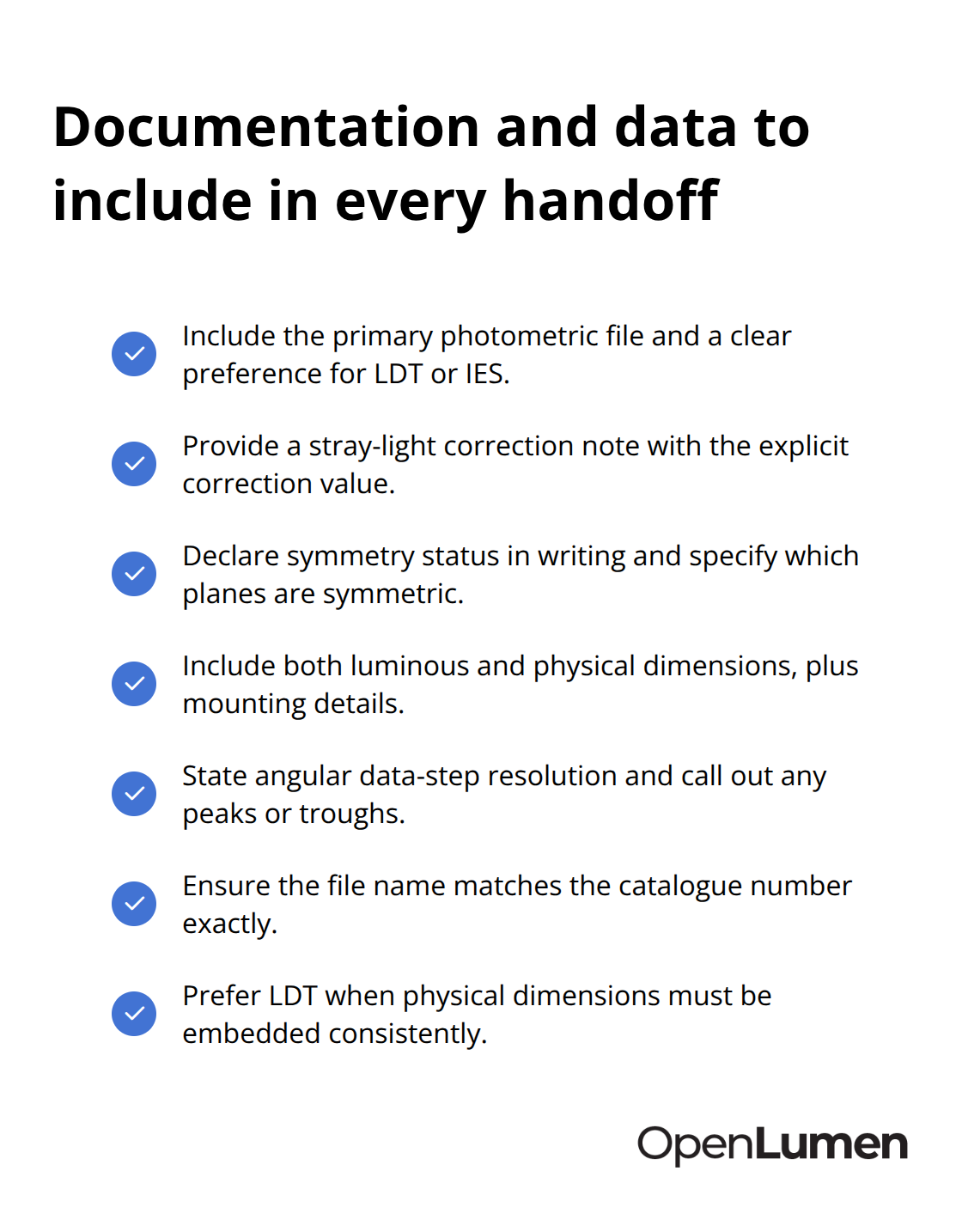
Symmetry status must appear clearly in writing: development prototype data are often non-symmetric while product data should be symmetric, yet non-symmetric product data frequently reaches designers without any flag. Specify which planes show symmetry and which don’t.
Essential Photometric Files and Formats
Both luminous and physical dimensions are critical. IES files describe luminous dimensions but not always physical size, and physical dimensions are often substantially larger, risking layout clashes with ducts, sprinklers, and structural elements that designers can’t see without that information. Include the luminous height in all four planes because a luminous height of zero in all four planes yields a false glare table that underestimates visual discomfort. Data-step details matter for narrow-beam luminaires: LED streetlights and similar fixtures require finer elevation steps (potentially 0.5°–0.1°) to capture peaks, while coarser steps miscalculate traffic illuminance and uniformity. For lambertian-like luminaires, about 19 data steps (0°–90° in 5° increments) suffice; excessive upper-range steps waste processing time without meaningful gain. Note which peaks and troughs appear in your angular distribution so designers don’t miss critical performance features. File naming must map clearly to the catalogue number: the file name should match the luminaire code exactly, and consistent naming saves designers time and reduces errors during handoff. Prefer LDT over IES for data handoffs, since IES describes only luminous dimensions and may require manual edits for physical size; LDT formats generally allow more consistent dimensional data and reduce back-and-forth clarification.
Verification Checklists Before Handoff
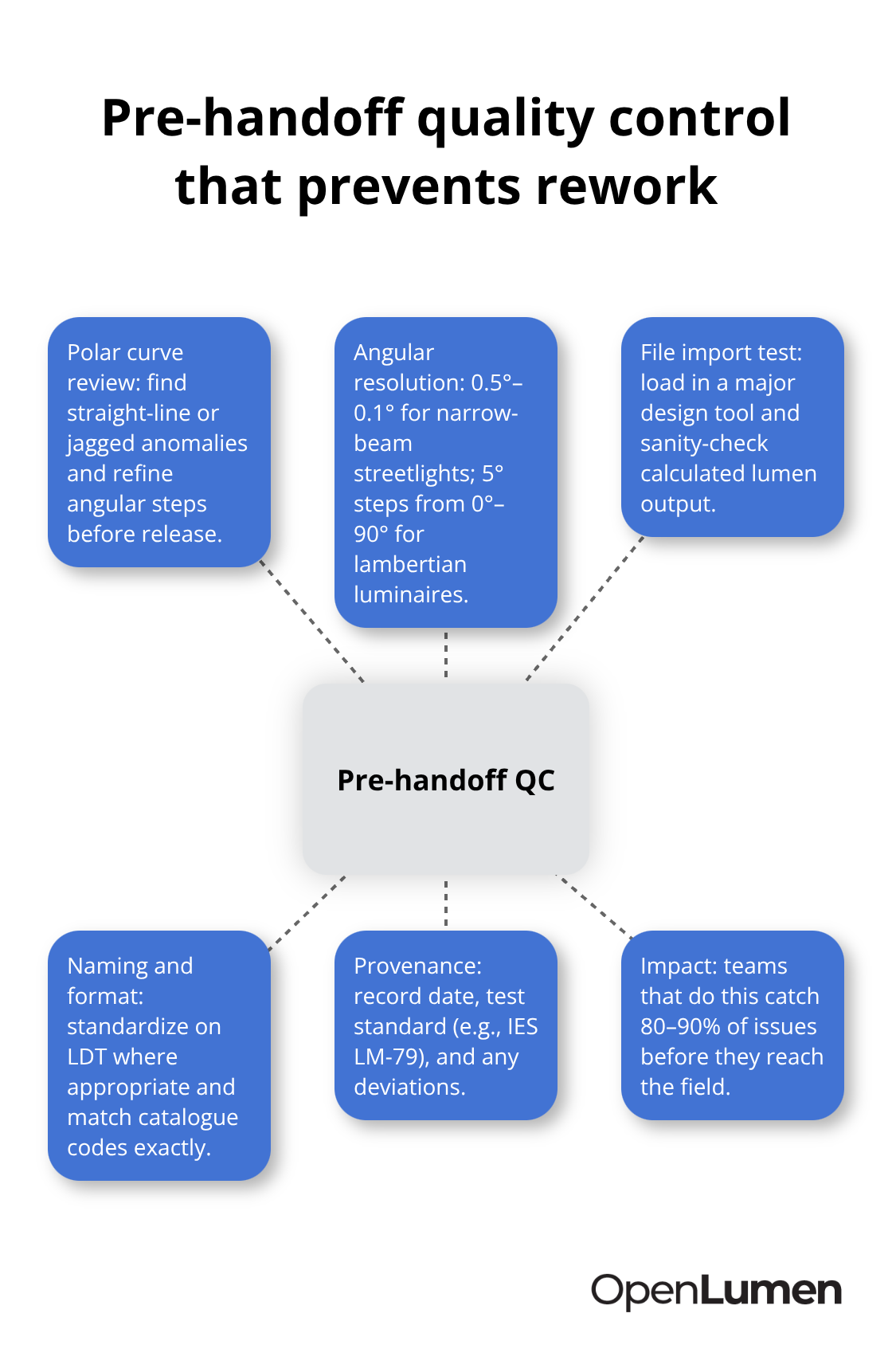
Create a simple checklist before any data leaves your lab or manufacturer. Confirm stray light has been measured and either removed or documented with the correction value stated. Verify symmetry status in writing for each plane. Cross-check that both luminous height and physical mounting dimensions appear in the documentation, not just one or the other. Run a polar curve plot and look for straight-line segments, which typically indicate too coarse data steps, or jagged curves that signal unrealistic data. If you see either, refine your angular steps before handoff. Validate that file naming matches your catalogue number exactly and that the luminaire name field stays under 78 characters to avoid truncation in design software. Test the file import in at least one major design tool to confirm it loads without errors and that calculated lumen output makes sense relative to your known fixture specifications. Document the data provenance: where the measurements came from, which test standard was followed, and the date of measurement. This context prevents designers from using outdated or non-representative data months later.
Tools and Platforms for Streamlined Data Sharing
Hand off a single, consolidated data package that includes the primary photometric file (LDT preferred), a stray-light correction note, symmetry declaration, a dimensional drawing or specification showing both luminous and physical size, data-step notes highlighting any peaks or troughs, the file-name-to-catalogue mapping, measurement date and standard used, and a reference to IES/IESNA or CIE conventions for quality context. Most teams waste time hunting through email threads and shared folders for these pieces. A single PDF cover sheet with links to each component eliminates that friction. When designers receive everything at once with clear labels, they spend less time verifying data quality and more time designing. This approach also protects you: if a designer later claims the data was incomplete or inaccurate, you have documented proof of exactly what you provided and in what condition.
Once your data package reaches the designer’s hands, the real work begins. The next section covers how designers and contractors should interpret this information and integrate it into layouts that actually perform as specified.
Making Photometry Handoffs Work in Real Projects
The gap between documented best practices and what actually happens on job sites is where handoffs fail. Clarity at specific moments before data moves forward determines success. No photometric data leaves a lab or manufacturer without a single responsible person approving the consolidated data package against the checklist from the previous section. This person owns the handoff. They verify stray-light corrections are documented, symmetry status is declared in writing, both luminous and physical dimensions are present, file naming matches catalogue numbers, and the data loads without errors in at least one design tool. This takes 30 minutes per luminaire type. Skipping it costs 10–20 hours later when designers call asking why their calculations don’t match field results.
Standardize Your Handoff Format
Establish a single handoff document format that every team uses. This isn’t a template that people ignore. It’s a PDF cover sheet with hyperlinks to each required component-photometric file, stray-light note, symmetry declaration, dimensional drawing, data-step notes, provenance statement, and catalogue mapping. When designers receive everything labeled and organized in one place, they import the file correctly, understand the data limitations, and avoid the back-and-forth clarification that derails schedules. Teams that use this approach report handoff resolution times drop from 5–7 days to 1–2 days.
Catch Problems Before They Reach Designers
Quality control during handoff means catching problems before they reach designers, not after. Run polar curve plots on every data set and look for straight-line segments, which indicate data steps that are too coarse, or jagged curves that signal unrealistic measurements. If you see either, refine your angular resolution and remeasure. For narrow-beam LED streetlights, use elevation steps of 0.5° to 0.1° to capture peaks accurately; for lambertian luminaires, 5° steps over 0°–90° typically suffice.
Validate File Naming and Format Consistency
Validate file naming consistency across your entire product line-if your catalogue uses codes like SL-LED-250-NW and your file is named streetlight_250.ies, designers will waste time matching them. Standardize on LDT format over IES because LDT allows you to embed both luminous and physical dimensions consistently, reducing manual edits and errors downstream. Test every file import in at least one major design platform before release; many tools will load corrupted or incomplete data without warning.
Document Measurement Provenance
Document the measurement date, test standard used (IES LM-79, for example), and any deviations from standard procedure. This protects you later and gives designers confidence the data is current and reliable. Teams that implement these checks catch 80–90% of potential issues before they reach the field, where fixes become exponentially more expensive.
When a designer receives a complete, verified data package, they move forward with confidence instead of spending hours verifying what should have been verified upstream.
Conclusion
Photometry handoff guidelines move accurate, complete data from one team to the next without loss, confusion, or delay. The steps outlined here-documenting stray-light corrections, declaring symmetry status, including both luminous and physical dimensions, standardizing file naming, and verifying data quality before transfer-prevent projects from stalling while teams hunt for missing specifications or troubleshoot inflated lumen calculations. A single handoff failure costs 10–20 hours of designer time, contractor rework, or facility owner disappointment, and that expense multiplies across a year of projects.
Teams that implement these photometry handoff guidelines report resolution times drop from 5–7 days to 1–2 days. Assign one person to verify every photometric data package against a checklist before it leaves your organization-this person confirms stray light is documented, symmetry is declared, dimensions are complete, file naming is consistent, and the data loads without errors in a design tool. This takes 30 minutes per luminaire type and prevents most downstream problems.
Proper handoffs build confidence across your entire pipeline. Designers trust the data they receive, contractors install fixtures knowing dimensions match layouts, and facility owners see lighting that performs as promised. Use OpenLumen to validate photometric data instantly and catch quality issues before you commit to a design, saving hours of rework and giving you confidence your calculations match field performance.
The information provided is for general educational purposes only and should not be considered professional engineering or lighting design advice. Always verify project requirements, local codes, and specifications with qualified professionals before making final decisions.