Photometric data standards are the foundation of reliable lighting design. Without them, projects suffer from miscommunication, wasted resources, and poor results.
At OpenLumen, we’ve seen firsthand how inconsistent data creates real problems on job sites. This guide walks you through the standards that matter, how to use them correctly, and why they’re worth your attention.
What Photometric Data Actually Means
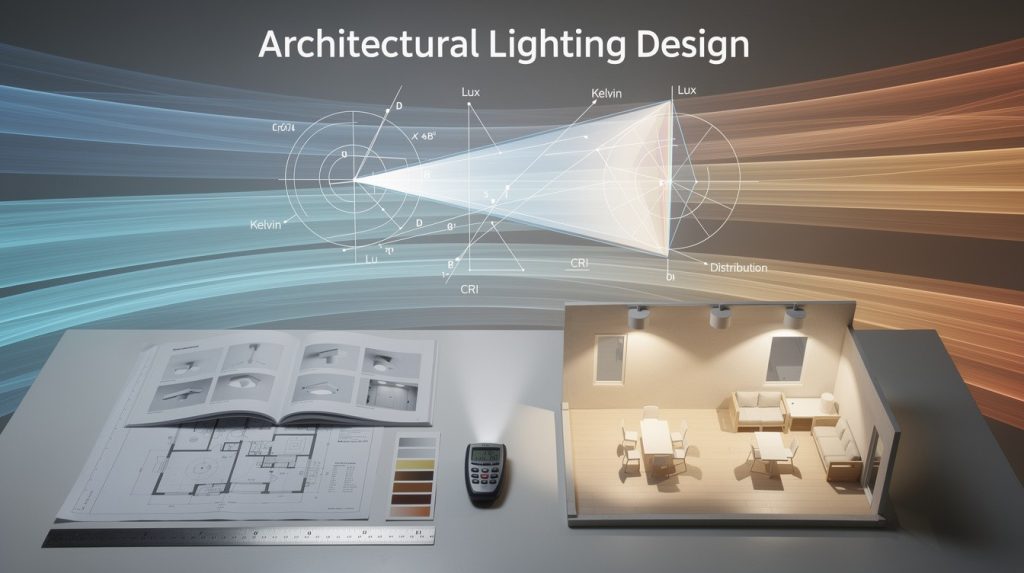
Photometric data describes how a light fixture distributes light in three-dimensional space. It captures candela values at every horizontal and vertical angle, lamp specifications, and luminous-opening dimensions. This data lives in standardized files-IES (Illuminating Engineering Society) format in North America and EULUMDAT in Europe-that design software reads to simulate real-world light coverage before installation. Without accurate photometric data, you guess about footcandle levels, uniformity, and compliance. With it, you know exactly what you’ll get. The difference between these two states determines whether a project works or fails on the job site.
Why Inconsistent Data Breaks Projects
Manufacturers sometimes provide photometric data that doesn’t match their actual products. A fixture spec sheet lists one optic, but the IES file describes another. The data sits two years old, reflecting outdated components. The lab that tested it wasn’t accredited, so the measurements are optimistic.
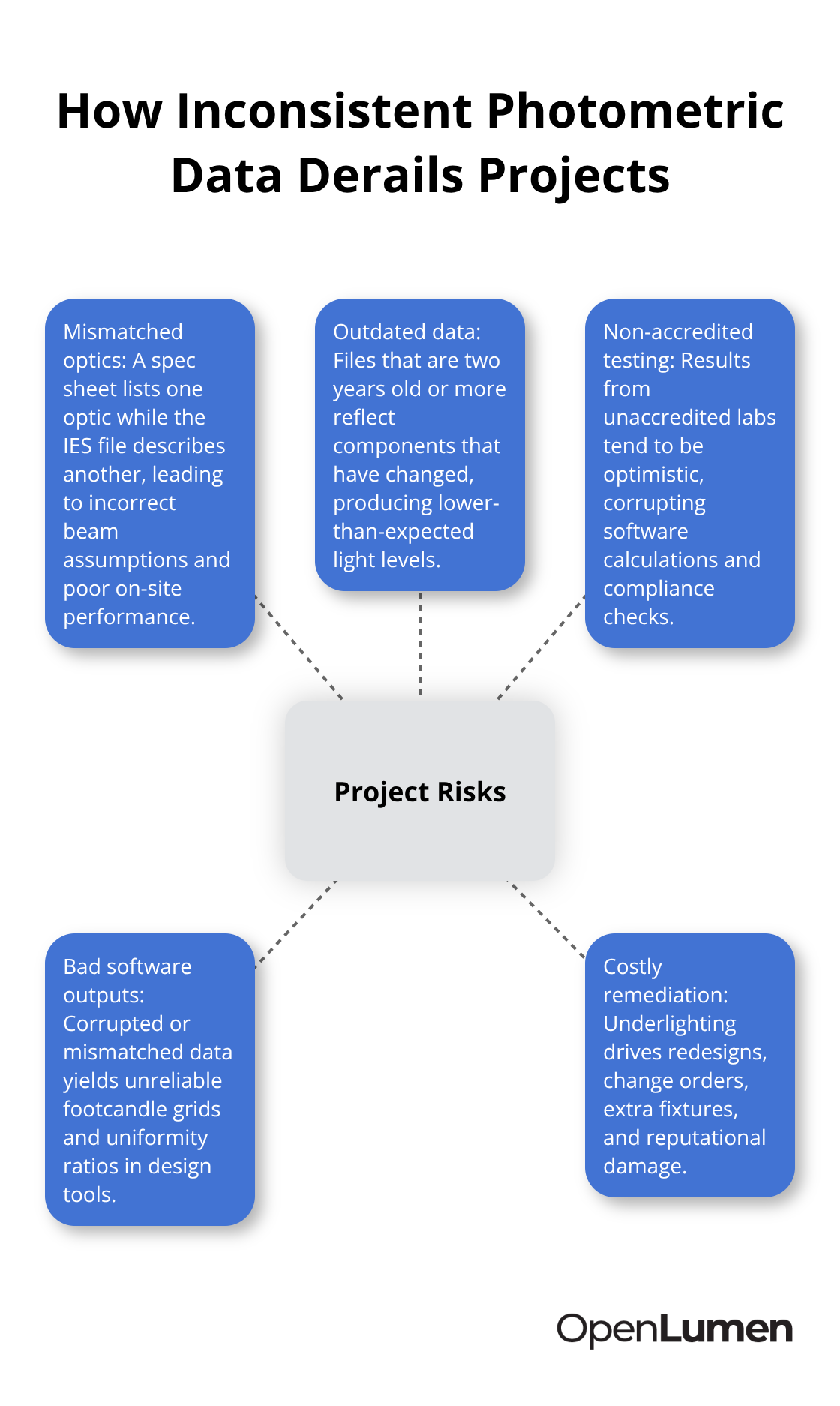
When your design software loads this corrupted or mismatched data, it calculates footcandle grids and uniformity ratios based on fiction. You specify 50 fixtures thinking you’ll hit 30 footcandles across a parking lot; installation reveals 22. The customer complains. You redesign. You order more fixtures. The project loses money and your reputation takes a hit.
This happens because photometric standards weren’t followed. Accredited laboratories measure fixtures per EN 13032-1, documenting measurement uncertainty and using calibrated Type C goniophotometers. Manufacturers who skip this step cut corners to save money. You pay the price later.
How Standards Protect Your Work
Photometric standards force consistency. IES LM-63-19 defines exactly how luminous intensity distribution data must be structured and reported. EULUMDAT does the same for European projects. When you demand that a manufacturer provide IES data measured by an accredited laboratory, you protect your project. The luminaire schedule in a photometric study lists every fixture’s wattage, lumen output, beam angle, color temperature, and quantity. If the study uses the correct IES file for the exact product you’re quoting, the results are trustworthy. If it doesn’t, they’re worthless.
Standards also enable software interoperability. A photometric study created in DIALux using proper LDT files loads correctly in AGi32 or Visual Lighting Design. Without standards, that file might fail to load or display incorrect data. Standardized data formats mean faster workflows, fewer surprises, and projects that perform as designed when fixtures arrive on site.
What to Demand From Your Manufacturers
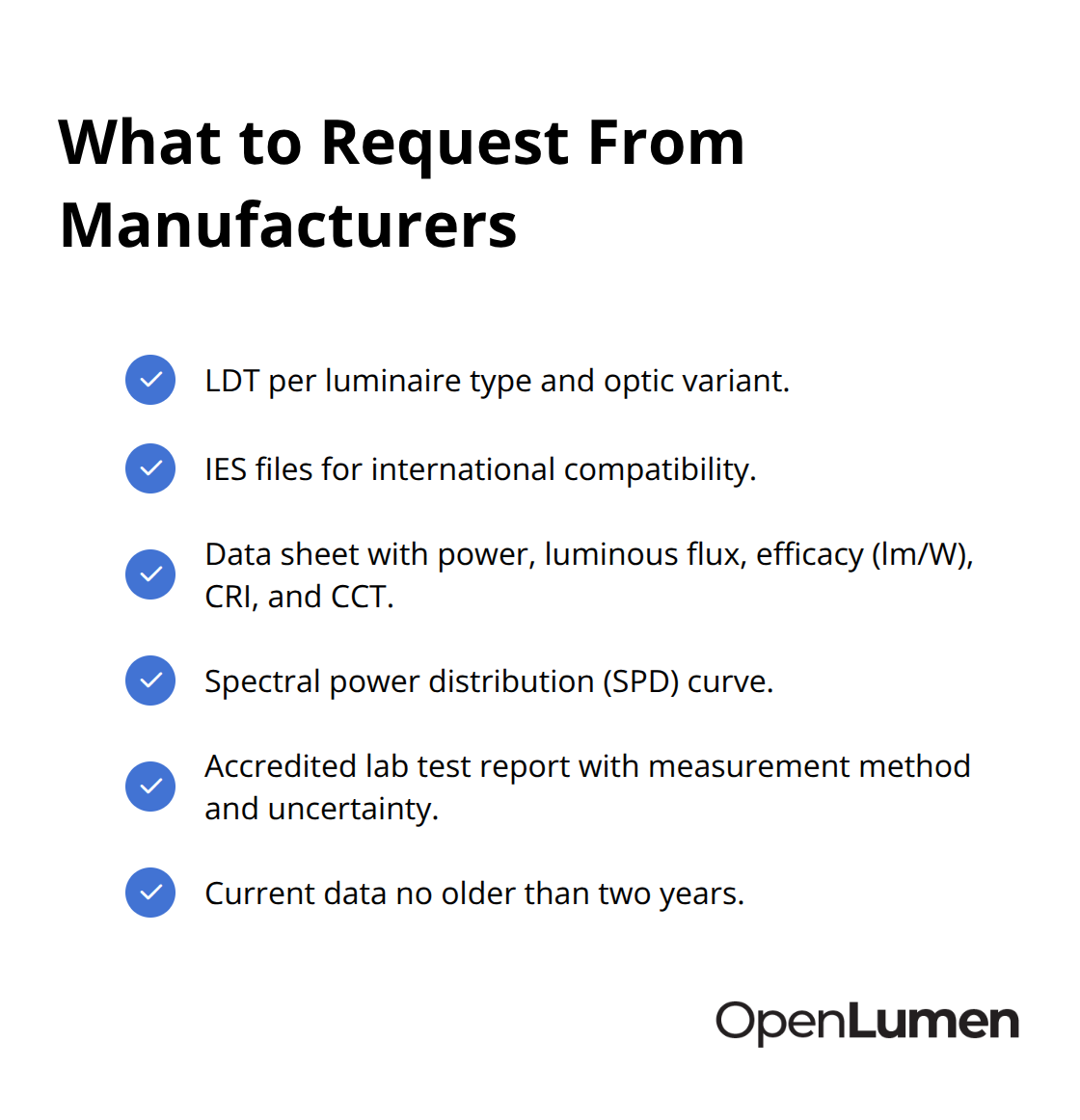
Request LDT per luminaire type and optic variant; IES for international compatibility; a data sheet with power, luminous flux, efficacy (lm/W), CRI, and CCT; an SPD curve; a test report with laboratory details and measurement method; and current data no older than two years. If a manufacturer cannot provide LDT files derived from goniophotometer measurements, treat this as a red flag for data reliability. In-house manufacturer measurements can be acceptable but carry the risk of optimistic values without external validation. Theoretical or simulated data is not sufficient for professional projects; actual measurements guarantee real-world performance.
The standards you enforce today determine the quality of your projects tomorrow. When you move into selecting reliable data sources and validating photometric information, you’ll see how these principles translate into concrete steps that protect every project you touch.
Common Photometric Standards and Formats
IES LM-63-19: The North American Standard
North America runs on IES LM-63-19, the Illuminating Engineering Society’s standard for photometric data files. This format describes how a luminaire distributes light using candela values at every measured angle pair, plus lamp wattage, luminous flux, beam type, and opening dimensions. IES files use the .ies extension and load into tools like AGi32, Visual Lighting Design, and Autodesk Revit. When you work on a North American project, demand IES data from manufacturers. The version matters more than most contractors realize. IES LM-63-2002 is outdated; modern practice uses LM-63-19, and the version should appear in the file header. If a manufacturer sends you data without specifying which version they used, ask for clarification before loading it into your software. Outdated versions can cause compatibility issues or fail to load entirely.
EULUMDAT and European Standards
Europe uses EULUMDAT, also called LDT format, which contains the same core information as IES but structures it differently. LDT files use the .ldt extension and work natively in DIALux and Relux. Both formats serve the same purpose: they give design software the raw data it needs to calculate footcandle grids and uniformity ratios accurately. When you bid European work, request LDT files. For international tenders, insist on both formats. A manufacturer that can only provide one format limits your options and signals they don’t serve a global market seriously.
Accreditation and Measurement Integrity
In-house testing labs often cut corners by skipping accredited measurement procedures, which means the data reflects ideal conditions rather than real-world performance. Accredited laboratories measure per EN 13032-1 using Type C goniophotometers and document measurement uncertainty in their test reports. When you receive photometric data, check the test report for the laboratory name and whether it holds accreditation. If the manufacturer tested in-house without third-party validation, treat those numbers skeptically. A properly measured IES file from an accredited lab costs more upfront but saves money when your first photometric study matches what actually installs on site.
Verifying Data Accuracy and Currency
The ies-library aggregates roughly 200,000 manufacturer files for easy reference, but not all files in public libraries are current or accurate. Verify the data matches your exact fixture model, optic type, wattage, and color temperature before you use it in a design. Request LDT per luminaire type and optic variant; IES for international compatibility; a data sheet with power, luminous flux, efficacy (lm/W), CRI, and CCT; an SPD curve; a test report with laboratory details and measurement method; and current data no older than two years. If a manufacturer cannot provide LDT files derived from goniophotometer measurements, treat this as a red flag for data reliability. Theoretical or simulated data is not sufficient for professional projects; actual measurements guarantee real-world performance.
Building Your Data Validation Workflow
The standards you enforce today determine the quality of your projects tomorrow. When you move into selecting reliable data sources and validating photometric information, you’ll see how these principles translate into concrete steps that protect every project you touch.
Implementing Standards Into Your Workflow
Establish a Data Verification Protocol
Never use photometric data you cannot trace back to an accredited laboratory. When a manufacturer sends you an IES file, open the test report first. Look for the laboratory name and whether they hold accreditation under EN 13032-1. Ask whether they used a Type C goniophotometer and whether measurement uncertainty is documented. If the report is missing or vague, reject the data. A manufacturer that won’t stand behind their measurements isn’t worth your time.
Request LDT files for each luminaire type and optic variant separately-never accept generic files that claim to cover multiple products. The same fixture model with different lens coatings produces different light distributions. One file cannot describe both accurately. Demand current data no older than two years. Component aging, manufacturing tolerances, and LED color shifts mean data from 2022 doesn’t reliably predict 2026 performance.
Validate Fixture Specifications Before Design
When you receive data, verify the exact wattage, color temperature, and beam angle match what you intend to specify. A photometric study built on the wrong IES file delivers wrong footcandle predictions, and no amount of fixture count adjustments during design will fix that mistake once you’re on site.
Create a checklist before loading data into your design software: laboratory accreditation confirmed, measurement method documented, data currency verified, fixture model and optic type match, and both IES and LDT formats provided for international projects. Store approved files in a centralized, version-controlled library accessible to your entire team. This prevents colleagues from accidentally using outdated or incorrect files buried in old project folders.
Inspect Data Visually in Your Design Tool
When you import LDT into DIALux or IES into AGi32, the software renders the luminous intensity distribution so you can visually confirm the beam pattern looks correct before running calculations. Mismatched data often produces visually obvious distribution errors-asymmetrical beams, missing candela values, or inverted patterns-that a quick visual inspection catches immediately.
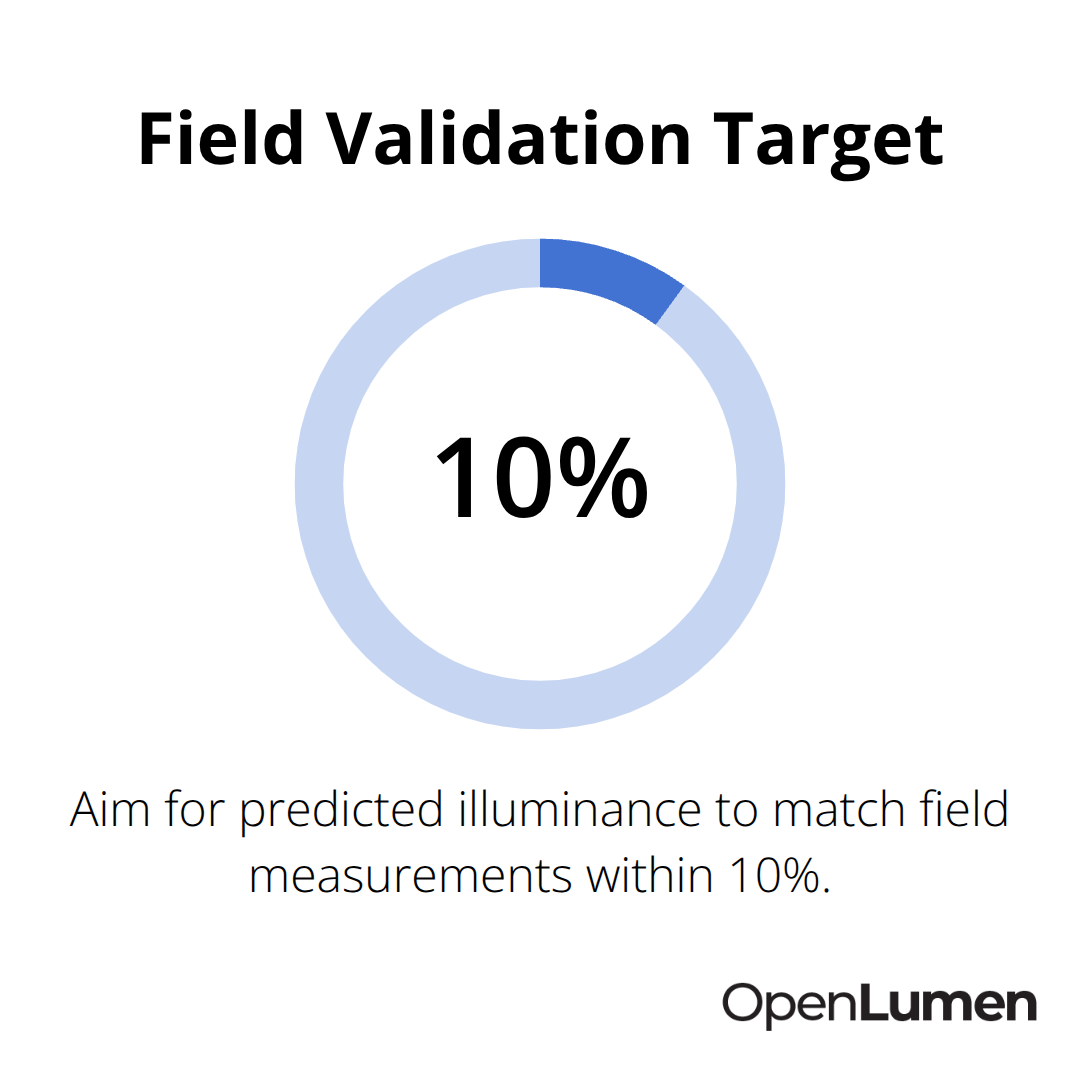
Test your workflow on a simple project first. Run a photometric study using standard fixtures from your verified library, then compare the predicted footcandle grid against actual measurements taken on a completed installation. If predictions matched reality within 10 percent, your data sources and process are sound. If results diverged significantly, trace back to the IES file and request fresh measurements from the manufacturer.
Scale Your Process Across Projects
This validation step takes a few hours but prevents costly surprises on larger projects. Once you’ve proven the workflow works, you can scale it confidently across your entire project pipeline. The standards you enforce today determine the quality of your projects tomorrow.
Final Thoughts
Photometric data standards stop you from guessing and force you to know exactly what each project will deliver. IES LM-63-19 in North America and EULUMDAT in Europe protect your reputation and your budget by eliminating the variables that cause redesigns and customer complaints. When you demand accredited laboratory measurements, current data no older than two years, and exact fixture specifications matched to IES files, you transform lighting design from a risky guessing game into a predictable, repeatable process.
The next step requires action: stop accepting photometric data without proof of accreditation, request test reports from manufacturers, and verify laboratory credentials before you load any file into your design software. When manufacturers resist or claim they cannot provide accredited measurements, that resistance signals they cut corners elsewhere. Find suppliers who stand behind their measurements and who understand that photometric data standards matter for every project you touch.
We at OpenLumen built our platform to make this process faster and more accessible. Visit OpenLumen to see how verified photometric data and instant metrics let you validate information in real time without expensive software or complex workflows-you can create photometric layouts, run illuminance analysis, and generate professional reports directly in your browser.
The information provided is for general educational purposes only and should not be considered professional engineering or lighting design advice. Always verify project requirements, local codes, and specifications with qualified professionals before making final decisions.