Getting lighting right depends on picking the calculation method that fits your project. Whether you’re designing a small office or a complex warehouse, the approach you choose affects both your timeline and results.
At OpenLumen, we’ve seen contractors waste weeks on manual calculations for projects that need digital precision, and others overcomplicate simple layouts with unnecessary software. This guide walks you through lighting calculation methods so you can match the right tool to your actual needs.
Manual Calculation Methods for Lighting Design
Point-by-Point Calculations Expose Real Variations
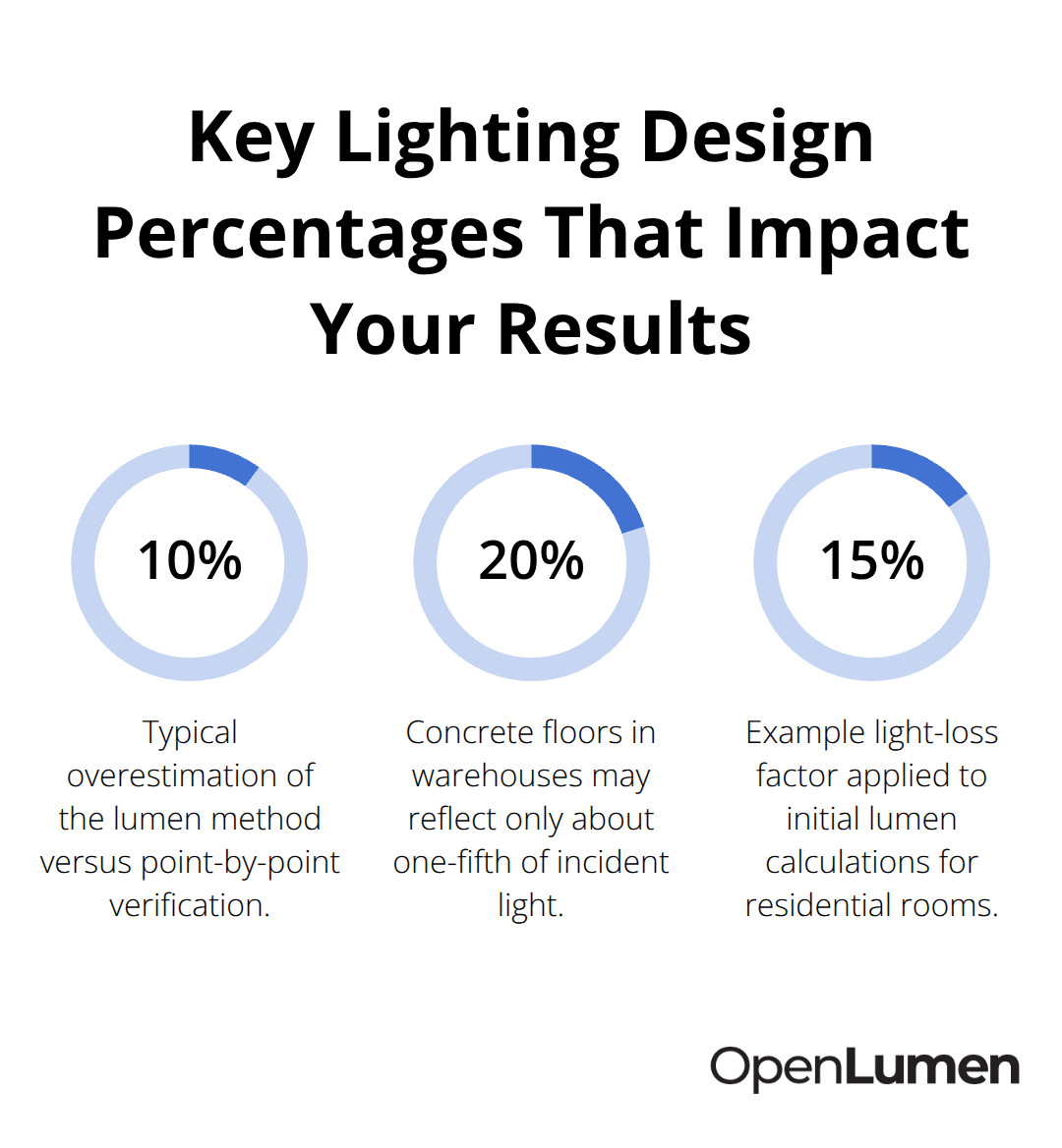
The point-by-point calculation technique remains the most accurate manual approach because it measures illuminance at specific locations across your space rather than averaging across the entire area. You identify key work surfaces-desks, countertops, assembly lines-and calculate how much light reaches each spot based on fixture distance, angle, and output. The inverse-square law governs this relationship: light intensity drops proportionally to the square of the distance from the source. A 400-lumen fixture at 3 feet delivers roughly 44 foot-candles on a surface directly below it, but at 6 feet that same fixture produces only 11 foot-candles. Point-by-point calculations expose these variations, which matters because the IESNA Zonal Cavity Method (the standard lumen method) typically overestimates results by about 10 percent compared to point-by-point verification. This gap widens in rooms with obstacles, dark finishes, or irregular layouts where the averaged lumen method fails.
The Lumen Method Prioritizes Speed Over Detail
The lumen method works differently-it calculates total light output needed to achieve an average illuminance across the entire work plane, then divides that total by individual fixture output to determine how many fixtures you need. The formula is straightforward: lumens needed equals area in square feet multiplied by your target foot-candles. A 1,200-square-foot office requiring 40 foot-candles needs 48,000 lumens total. Divide that by a 20,000-lumen fixture and you get roughly 2.4 fixtures, rounded to 3. This method works fast for simple rectangular rooms with uniform ceiling heights and reflectance, but it masks problem areas. You sacrifice visibility into how light actually distributes across your space.
Grid-Based Analysis Catches Real-World Problems
Grid-based analysis bridges both approaches-you divide your space into a grid, calculate illuminance at each grid intersection, then adjust fixture count and spacing until uniformity improves. This reveals whether your layout creates dark corners or hot spots before installation. The maximum recommended spacing between fixtures is the spacing criterion multiplied by the difference between mounting height and work-plane height. Exceed that spacing and you risk visible shadows between fixtures. For a 12-foot ceiling with a 30-inch work plane, a spacing criterion of 1.5 means fixtures should be no more than 16.5 feet apart. Manual grid analysis is tedious-you run dozens of calculations by hand-but it catches real-world problems that the lumen method misses. Contractors who skip this step often end up overlighting to compensate for poor uniformity, wasting energy and creating glare.
When Manual Methods Reach Their Limits
The practical reality is that manual methods excel for small, simple spaces but become unreliable as room complexity increases. A straightforward rectangular office with uniform finishes responds well to the lumen method. A warehouse with racked storage, multiple ceiling heights, and dark concrete floors demands either point-by-point rigor or digital tools that handle the complexity automatically. The choice between these manual approaches depends on your project scope and tolerance for calculation time. For anything beyond basic layouts, digital solutions offer speed and accuracy that manual work cannot match.
Why Digital Tools Beat Manual Calculations for Real Projects
Instant Calculations Replace Hours of Manual Work
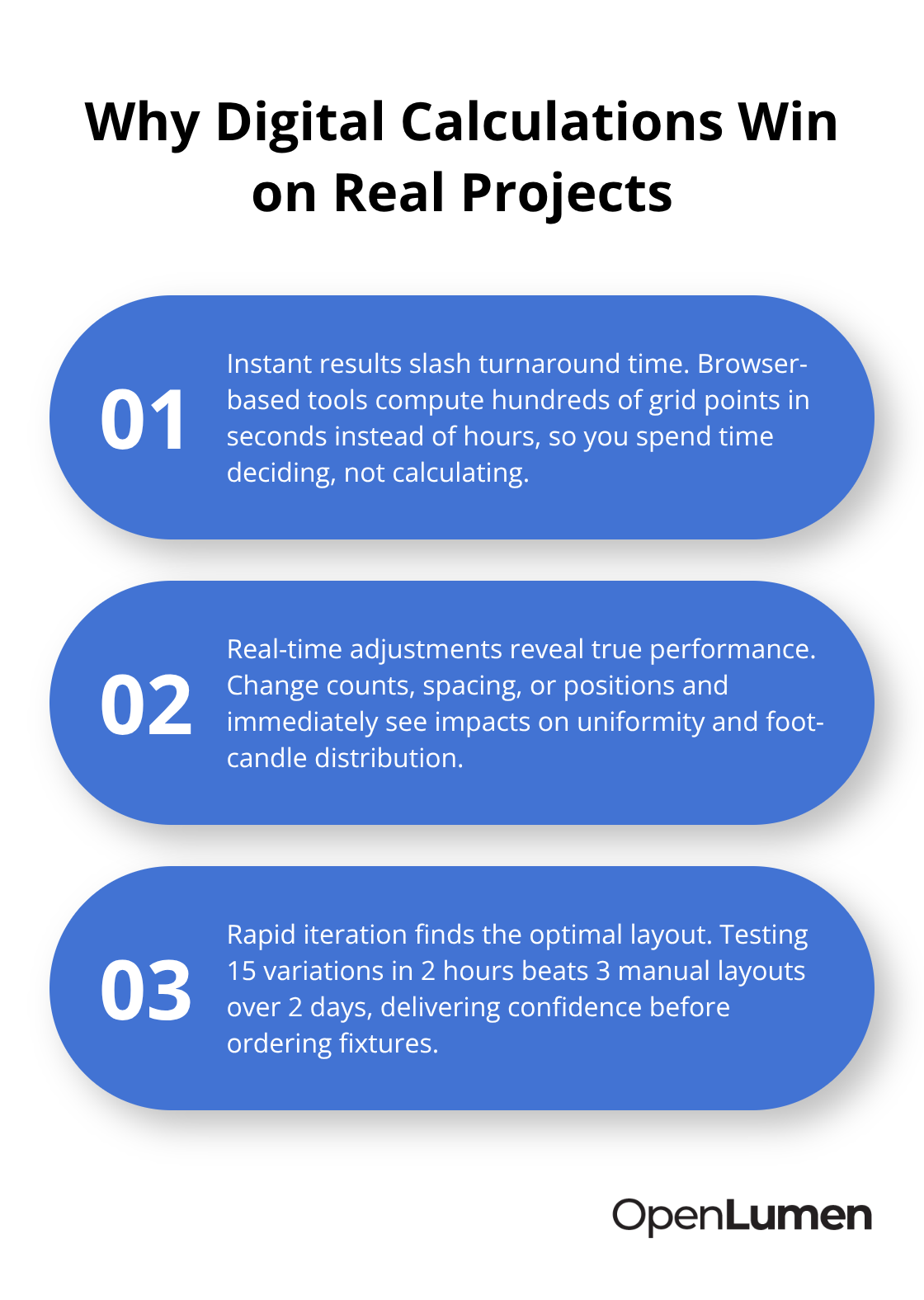
Digital lighting design platforms eliminate the tedium of manual calculations while exposing problems that averaged methods hide. When you use browser-based software, you input your room dimensions, select fixtures from a verified luminaire library, and the system instantly calculates illuminance at hundreds of grid points across your space. This happens in seconds instead of hours. The real advantage emerges when you adjust fixture count, spacing, or position-results update in real time so you see exactly how each change affects uniformity and foot-candle distribution. A warehouse designer working manually might test three layouts over two days; the same designer using digital tools tests fifteen variations in two hours and picks the optimal solution with confidence.
Real-Time Feedback Transforms Design Decisions
Real-time analysis lets you experiment without penalty. You move a fixture two feet, and the software recalculates illuminance across the entire space instantly. You reduce fixture count by one unit, and uniformity ratios update immediately. This rapid iteration reveals which design choices actually matter and which ones waste money. Manual methods force you to commit to a layout before you fully understand its performance, which often leads to over-lighting as a safety margin. Digital tools eliminate that guesswork because you test variations and verify performance before ordering a single fixture.
Professional Reports Prove Your Design Works
Professional report generation separates serious design proposals from rough sketches. Digital platforms automatically produce illuminance maps showing foot-candle values across your work plane, uniformity ratios that verify compliance with standards, and fixture schedules that specify exact locations and quantities. A contractor can generate a proposal document in minutes that demonstrates to a property owner exactly what the finished lighting will deliver-no ambiguity, no surprises during installation. This documentation also becomes your installation guide, reducing on-site errors and rework. The photometric data embedded in these reports proves your design meets code requirements and performance targets, which protects you if disputes arise later.
Energy Code Compliance Happens Automatically
For complex projects like warehouses, manufacturing facilities, or retail spaces with multiple zones, digital tools calculate Lighting Power Density (LPD) automatically, showing whether your design meets energy code limits. This matters because the 2024 International Residential Code now requires manual dimmers or occupancy sensors in habitable rooms, and digital platforms help you plan these controls into your initial design rather than retrofitting them afterward. The speed advantage compounds when clients request revisions-you adjust parameters and regenerate reports in minutes instead of recalculating everything by hand.
Accuracy Matters More Than You Think
The photometric data embedded in digital tools comes from actual manufacturer specifications rather than estimates or averages. This eliminates the 10 percent variance that plagues manual methods and ensures your calculations reflect real-world performance. When you work with verified luminaire data (not guesses), your designs perform as promised, which builds client trust and reduces warranty claims. The difference between a design that works and one that merely looks good on paper often comes down to whether you used actual photometric data or approximations.
With accurate calculations and instant feedback in hand, the next step involves knowing which projects truly need digital precision and which ones still work with simpler approaches.
Comparing Methods: When to Use Each Approach
Small rectangular rooms with straightforward lighting needs still work fine with manual methods, but only if you accept their limitations and plan accordingly. A 1,200-square-foot office with uniform 9-foot ceilings and standard white drywall responds predictably to the lumen method-calculate 48,000 lumens at 40 foot-candles, divide by fixture output, and you land within acceptable range. The Zonal Cavity Method delivers reasonable results here because room geometry cooperates. Manual grid analysis adds value when you want to verify that fixture spacing avoids dark zones between lights, but for straightforward rectangular spaces, this extra step often feels excessive. The real cost of manual methods emerges when projects deviate from ideal conditions-and most real projects do. A warehouse with 25-foot ceilings, concrete floors reflecting only 20 percent of light, and racked storage blocking direct illumination becomes a calculation nightmare by hand. Point-by-point calculations require dozens of individual measurements around and between racks. The lumen method overshoots dramatically because it ignores the storage obstacles entirely.
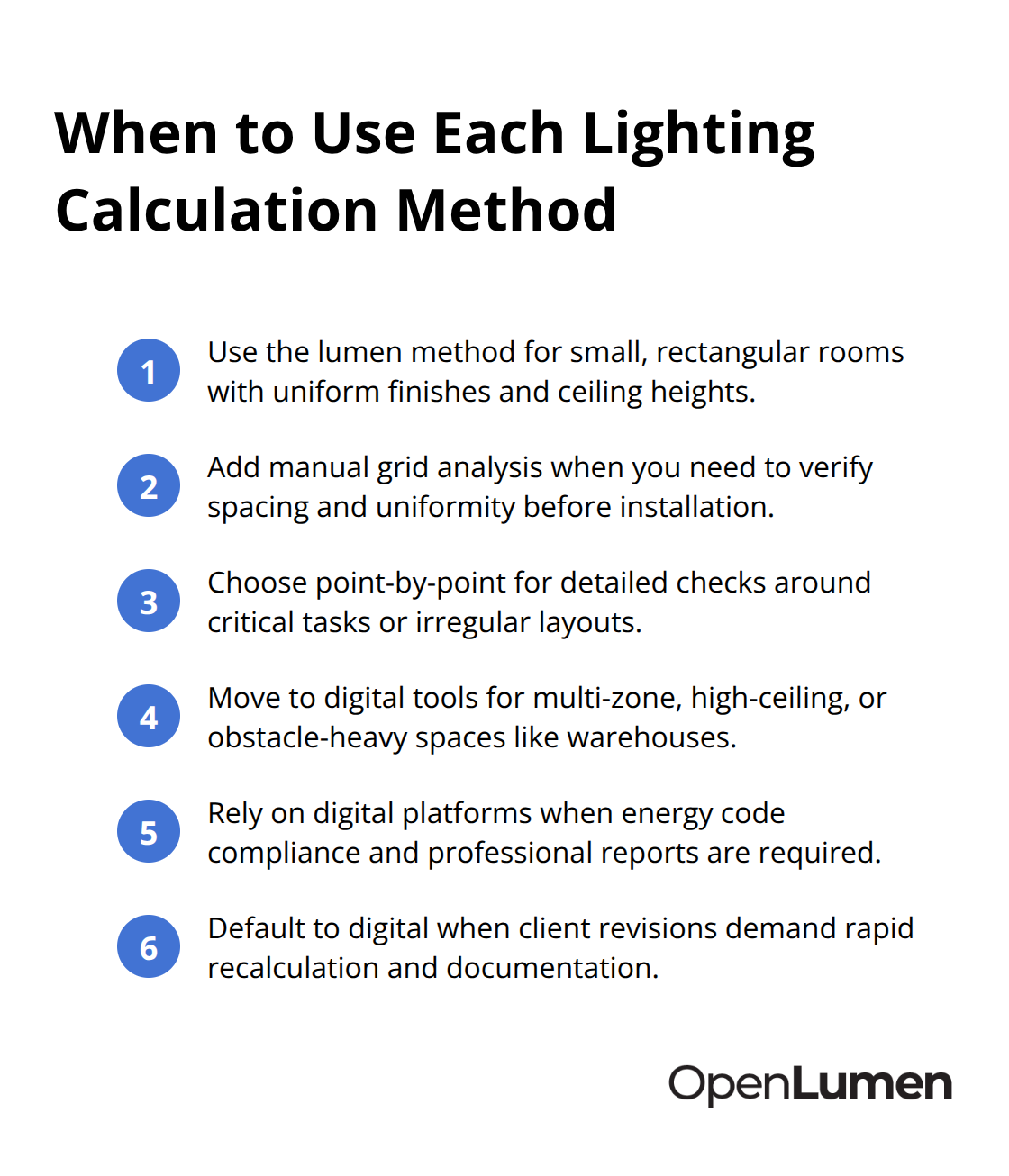
Grid-based analysis requires testing so many variations that manual work stretches into days. At this point, digital tools stop being optional and become necessary.
Manual Methods Work for Simple Residential Projects
Manual calculation methods retain value for preliminary estimates and education, but contractors who rely on them for final designs expose themselves to performance failures and warranty disputes. A quick lumen-method estimate helps you ballpark fixture count before detailed design work, which saves time in the proposal phase. Trainees learn lighting fundamentals through manual calculations because the process builds intuition about how distance, reflectance, and fixture output interact. For residential projects with straightforward layouts-bedrooms, kitchens, hallways-manual methods often deliver acceptable results because rooms are small, ceiling heights are consistent, and surfaces are predictable. A 14-by-15-foot bedroom at 5 foot-candles needs roughly 1,050 lumens initially, or 1,150 lumens after accounting for a 15 percent light-loss factor; a ceiling fixture plus two wall sconces easily meet this target without requiring digital verification. The cost of manual calculation time stays lower than the cost of software for single-room projects.
Digital Tools Handle Commercial Complexity
Commercial and industrial projects benefit overwhelmingly from digital design because complexity multiplies calculation effort exponentially. A 10,000-square-foot retail space with display zones requiring 75 foot-candles, general selling areas at 50 foot-candles, and back-of-house at 30 foot-candles demands zone-specific calculations that manual methods handle poorly. Digital platforms let you define multiple zones, assign different fixture types to each, and verify that transitions between zones feel natural rather than jarring. You see foot-candle distribution across the entire space instantly, identify whether any area falls below minimum targets, and adjust fixture placement within minutes. Manufacturing facilities with inspection stations requiring 100 foot-candles surrounded by general workspace at 50 foot-candles present similar complexity-digital tools handle this layered approach naturally while manual methods force you to design each zone separately and hope they integrate properly. The speed advantage compounds when clients request changes. A property owner sees the photometric layout and asks whether moving the fixture grid 2 feet north would improve uniformity-digital recalculation takes 30 seconds; manual recalculation takes hours.
Speed and Accuracy Work Together, Not Against Each Other
The conventional wisdom that manual methods offer speed while digital tools demand time fundamentally misunderstands how these approaches work. Manual calculations appear fast initially because you run simple formulas, but you sacrifice accuracy and completeness. A quick lumen-method estimate tells you approximately how many fixtures you need, but it says nothing about whether light distributes evenly, whether dark corners exist, or whether your design meets uniformity standards. When the installation reveals problems, you spend weeks troubleshooting and retrofitting-far more time than a detailed digital analysis would have required upfront. Digital tools deliver both speed and accuracy because they automate tedious calculations while exposing real performance. Testing 15 fixture layouts in 2 hours and selecting the optimal one beats testing 3 layouts manually over 2 days and hoping the chosen option works. The Lighting Power Density calculations that digital platforms generate automatically prove compliance with energy code requirements like the 2024 International Residential Code, eliminating post-installation code violations that force expensive redesigns. Professional report generation happens in minutes rather than days of manual documentation, which means contractors present polished, credible proposals that win projects and build client confidence. For projects with budgets exceeding $50,000, the time saved and errors prevented by digital analysis justify the platform cost within the first project.
Final Thoughts
Match your project scope to the lighting calculation method that delivers results without wasting time or money. Manual methods like the lumen method and point-by-point calculations teach you how lighting fundamentals work and serve well for small residential spaces where complexity stays low. They cost nothing upfront and require only basic math skills, but they expose you to accuracy gaps, mask real-world performance problems, and consume hours on projects where conditions deviate from ideal rectangular rooms with uniform finishes.
Digital tools eliminate these trade-offs by automating calculations while exposing exactly how light distributes across your space. Real-time feedback lets you test fixture variations in minutes instead of days, and professional reports prove your design meets code requirements before installation begins. For commercial and industrial projects, digital analysis stops being optional and becomes the only practical path to reliable results.
Use manual methods for preliminary estimates and small residential projects where you accept their limitations. Move to digital tools the moment your project involves multiple zones, complex geometry, energy code compliance, or budgets exceeding $50,000. We at OpenLumen built a free, browser-based platform specifically to remove barriers between you and confident lighting design-OpenLumen gives you instant photometric analysis, a community-verified luminaires library, and professional report generation without expensive software or steep learning curves, so you design, test variations in real time, and generate credible proposals that win projects and build client trust.
The information provided is for general educational purposes only and should not be considered professional engineering or lighting design advice. Always verify project requirements, local codes, and specifications with qualified professionals before making final decisions.