Lighting design failures cost money. A miscalculated illuminance level, wrong color temperature, or poor uniformity forces expensive redesigns and client dissatisfaction.
At OpenLumen, we’ve seen how best practice lighting design eliminates these problems. The right approach combines foundational principles, avoids common pitfalls, and uses verification tools to validate every decision before installation.
Understanding Illuminance, Color Temperature, and Light Distribution
Illuminance Levels Drive Functional Performance
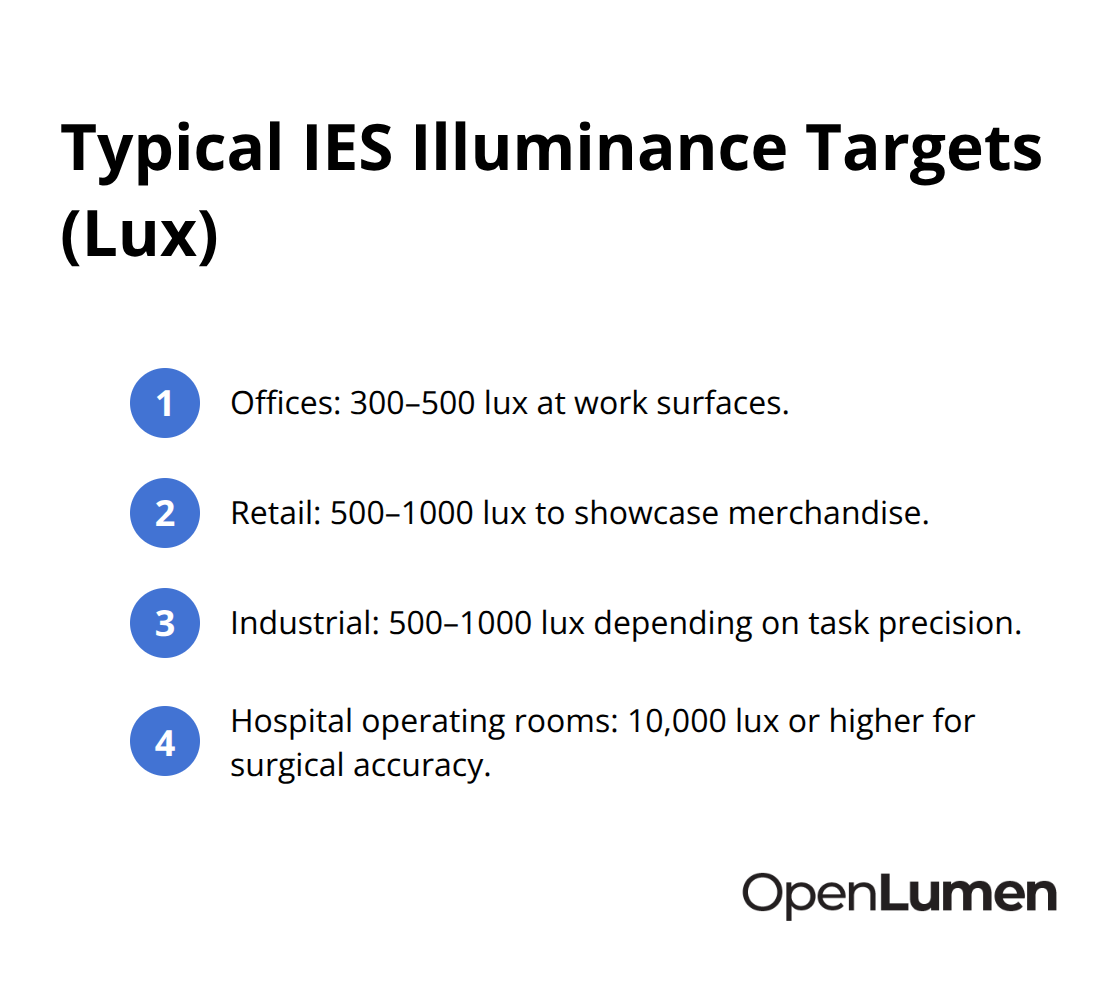
Illuminance levels form the foundation of functional lighting, and they vary dramatically by space type and task. The Illuminating Engineering Society publishes specific standards for different applications: office spaces typically need 300–500 lux on work surfaces, retail environments require 500–1000 lux to showcase merchandise effectively, and industrial facilities demand 500–1000 lux depending on task precision. Hospital operating rooms sit at 10,000 lux or higher because surgical accuracy depends on it.
Most designers treat illuminance as a one-size-fits-all number rather than a performance requirement tied directly to what people do in that space. If you specify 300 lux in a detailed assembly area, workers will struggle and make errors; if you over-specify at 1000 lux in a residential bedroom, you waste energy and create discomfort. Start with the primary task in each zone, then reference the IES standards for that specific task.
Color Temperature Shapes Perception and Alertness
Color temperature shapes how people perceive warmth and focus in a space, and it matters more than most designers acknowledge. Warm light at 2700K feels inviting and works well for living rooms, hospitality, and retail clothing because it flatters skin tones and creates relaxation. Cool light at 4000K performs better in offices and kitchens where alertness and color accuracy matter. Studies in K-12 schools show that proper color temperature and dimmability improve focus and support student transitions between activities. Mixing color temperatures in a single space creates visual chaos and signals poor planning. Select one dominant color temperature per zone and stick with it throughout the design.
Light Distribution and Uniformity Prevent Dark Spots
Light distribution and uniformity prevent the dark corners and harsh shadows that force occupants to add lamps or complain about poor lighting. Recessed downlights laid out in a grid deliver only about half their rated lumens to the space due to fixture optics, leaving walls underlit and wasting energy. Wall-mounted and pendant fixtures distribute light more evenly across the room. Try uniformity ratios no worse than 3:1 (maximum illuminance divided by minimum) in general areas; this keeps the space feeling balanced rather than spotty. Validating uniformity early through photometric analysis catches distribution problems before installation costs spike, which is why teams increasingly turn to tools that provide instant verification before committing to a design.
Common Lighting Design Mistakes and How to Avoid Them
Site-Specific Realities Demand On-Site Verification
Site-specific realities kill designs that looked perfect on paper. A lighting layout specified for a 10-foot ceiling fails when the actual ceiling sits at 12 feet with exposed ductwork that blocks fixture placement. Existing structural columns, window positions, and reflectance values of walls and floors shift illuminance and uniformity in ways that generic calculations miss. Teams often skip the site survey phase and pay for it later through costly redesigns and installation delays. Before finalizing any layout, document the actual ceiling height, identify obstacles, measure wall and floor finishes, and note external light sources like streetlights or large windows. This takes a few hours on-site but prevents thousands in rework. Equally critical: verify that your electrical infrastructure supports the design. Old buildings often lack adequate circuits or conduit runs for new fixtures, forcing expensive rewiring or compromises to the original plan. A quick electrical audit with the site team catches these constraints upfront.
Maintenance and Light Degradation Require Forward Planning
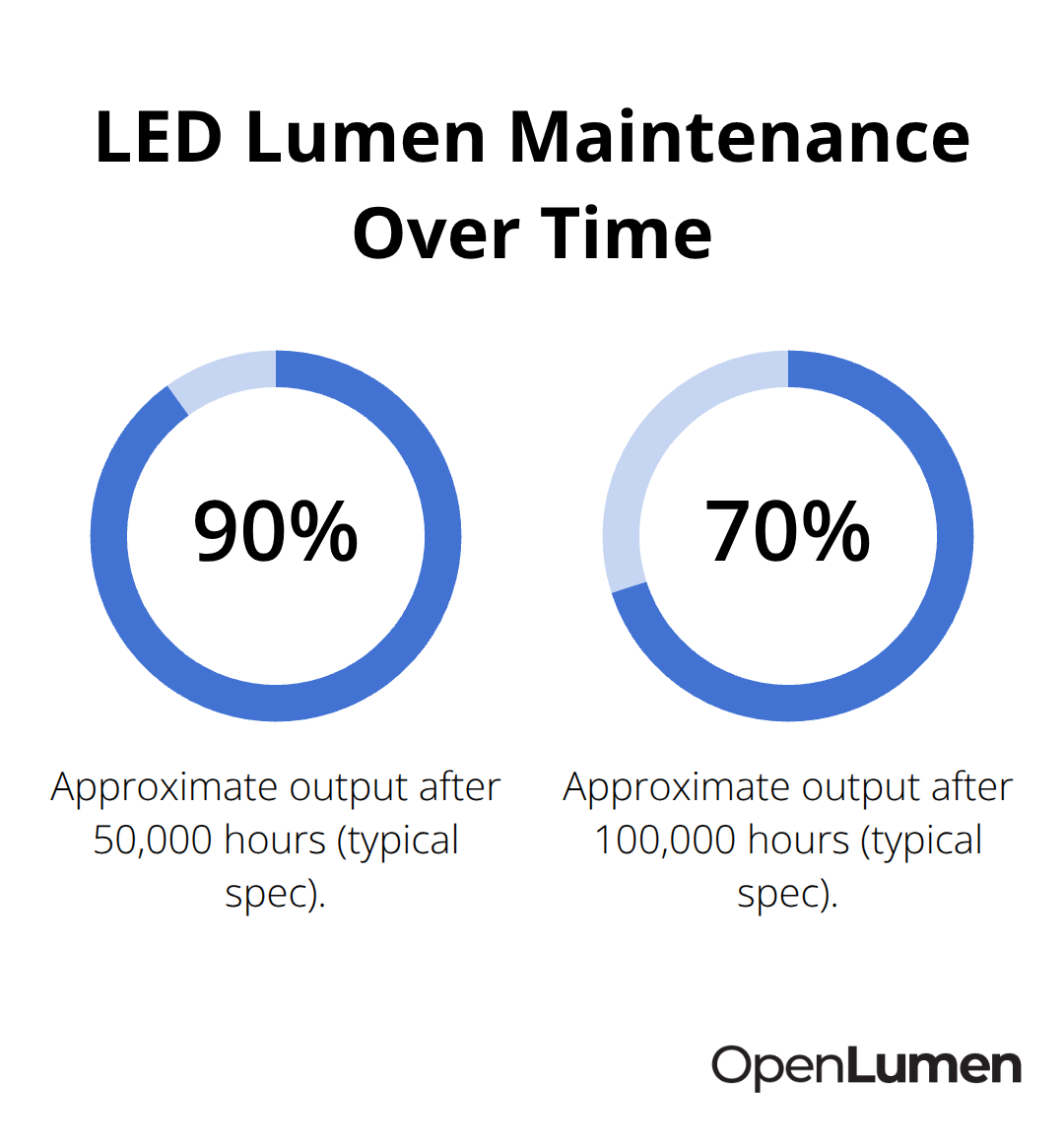
Maintenance and light degradation destroy performance if ignored during design. LED luminaires degrade to about 90 percent of initial output after 50,000 hours and 70 percent after 100,000 hours according to typical manufacturer specifications, yet most designs specify illuminance at initial output without accounting for this decline. If you design for exactly 300 lux in an office, the space drops to 210 lux within a decade, falling below the IES standard and forcing occupants to add supplemental lighting or tolerate poor visibility.
Design to the maintained illuminance level-typically 70 to 80 percent of initial output-so the space meets standards throughout its lifecycle. Dirt and dust accumulation also cuts light output by 10 to 30 percent depending on the environment and maintenance frequency. Industrial facilities with poor air quality need more aggressive cleaning schedules and higher initial specifications to stay compliant.
Energy Efficiency Drives Long-Term Value
Energy efficiency belongs in the initial design, not as an afterthought. Lighting accounts for 17 percent of electricity consumed in U.S. commercial buildings according to ENERGY STAR, making it the fastest payback for efficiency upgrades. Replacing incandescent fixtures with LEDs cuts electricity use by roughly 90 percent while delivering identical brightness and lasting 15 times longer than older bulbs. That translates to fewer maintenance visits and lower total cost of ownership across the building’s lifespan. Widespread LED adoption could cut the nation’s electricity use by the equivalent of 44 large power plants and save more than 30 billion dollars by 2027 according to ENERGY STAR projections. Design with LEDs from the start, specify dimmable controls to reduce consumption during off-peak hours, and layer your lighting so occupants can adjust brightness for different tasks rather than running everything at full power constantly. Utility rebates often cover 20 to 50 percent of LED upgrade costs, further improving financial returns and making efficiency a business advantage, not a cost burden. These upfront decisions about maintenance, degradation, and efficiency set the stage for designs that perform reliably and deliver measurable savings-which is exactly what validation tools help you confirm before installation begins.
How to Validate Lighting Designs Before Installation
Validation separates designs that work from designs that fail on-site. Photometric analysis catches illuminance shortfalls, uniformity problems, and color temperature mismatches before a single fixture ships. Most designers skip this step or rely on rough spreadsheet calculations, then scramble when the installed system falls short of client expectations. Real validation uses actual luminaire data to model light distribution across the space, accounting for ceiling height, wall reflectance, furniture placement, and maintenance degradation.
Real-Time Analysis Eliminates Design Surprises
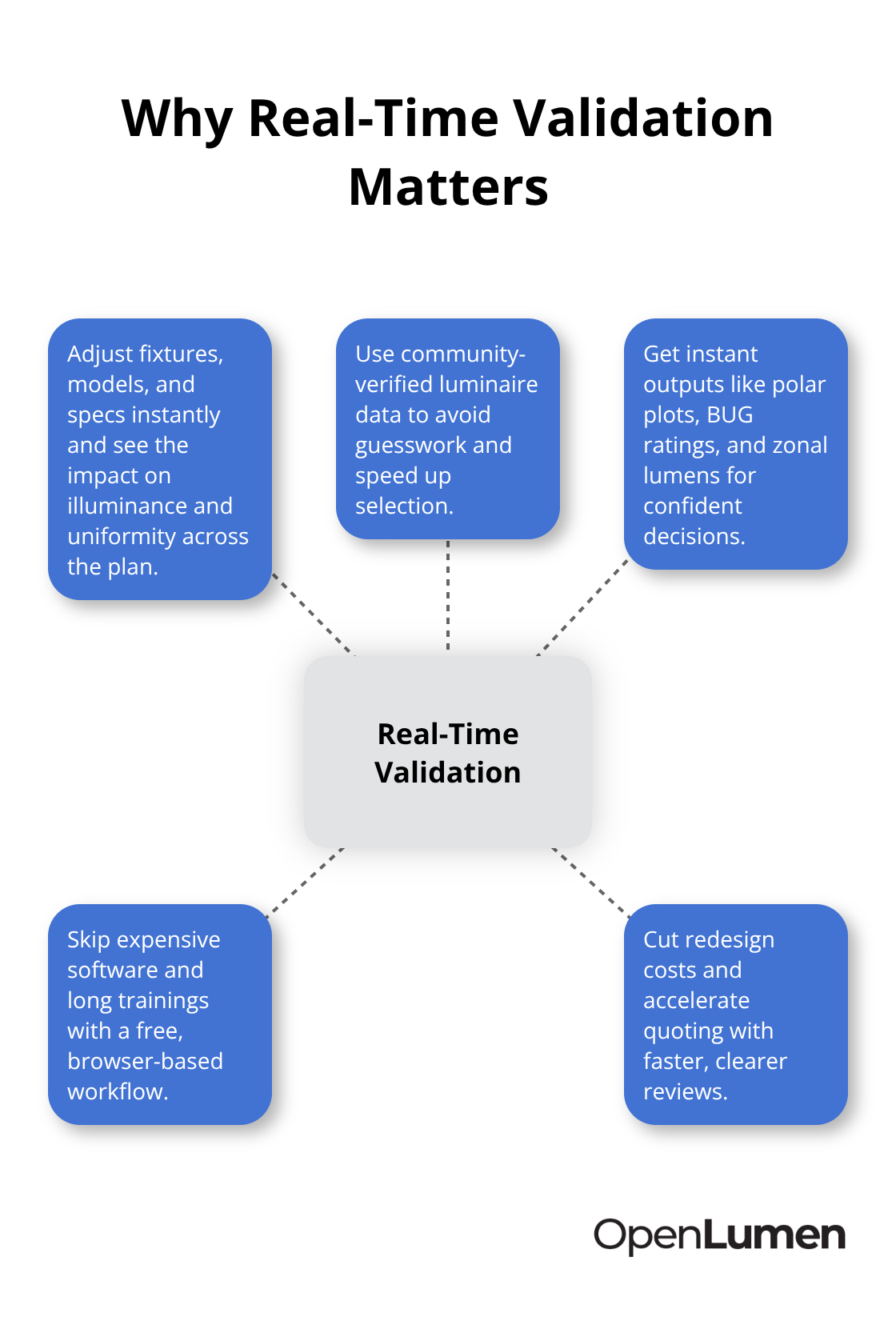
A photometric analysis tool that runs in real time lets you adjust fixture placement, swap luminaire models, or modify specifications instantly and see the impact on illuminance and uniformity across the entire floor plan. This workflow eliminates surprises and drastically cuts the cost of redesigns. Community-verified luminaire libraries accelerate this process-instead of hunting down spec sheets or guessing at performance, you pull tested photometric data directly into your layouts. OpenLumen provides this capability through a free, browser-based platform with a community-verified luminaires library and instant photometric analysis that generates polar charts, BUG ratings, and zonal lumens without expensive software or complex training.
Floor Plans Show What Numbers Cannot
Real-time illuminance verification transforms how you approach design reviews and client communication. Instead of presenting theoretical numbers, you show the client an actual floor plan with illuminance values at every work surface, color temperature consistency across zones, and uniformity ratios that prove the design meets standards. This visual validation eliminates vague conversations and builds trust. When a client asks why a particular area needs 500 lux instead of 300 lux, you point to the IES standard for that task and show the performance difference in the photometric model.
Maintenance Degradation Requires Upfront Adjustment
Validation catches maintenance degradation before it becomes a problem. If your analysis shows the space will drop to 210 lux after LED degradation over ten years, you adjust the initial specification upward during design rather than watching performance decline in the field. This forward-looking approach keeps spaces compliant throughout their lifecycle and prevents occupants from adding supplemental lighting later.
Validation Closes More Deals
Contractors who validate designs before quoting jobs close more deals because clients see proof of performance. Distributors who help contractors implement validation workflows become trusted partners rather than just product suppliers. Teams can design, validate, and generate professional reports in hours rather than days-a speed advantage that matters when contractors need to quote jobs quickly and facility owners want confidence before committing budget.
Final Thoughts
Best practice lighting design rests on three pillars: foundational principles that match illuminance to task, avoidance of common pitfalls that derail projects, and validation before installation commits budget and time. Proper planning cuts redesign costs dramatically because a site survey that takes a few hours prevents thousands in rework when ceiling height mismatches or electrical constraints surface. Accounting for LED degradation and maintenance during design keeps spaces compliant throughout their lifecycle rather than forcing occupants to add supplemental lighting years later.
Validation transforms confidence from assumption into proof through photometric analysis that runs in real time and lets you test fixture placement, swap luminaire models, and verify illuminance across the entire floor plan before installation begins. Community-verified luminaire libraries eliminate guesswork about performance data, and floor plans showing actual illuminance values, color temperature consistency, and uniformity ratios replace vague conversations with clients and build trust through transparency. Contractors who validate designs before quoting close more deals because clients see evidence of performance rather than promises.
OpenLumen provides a free, browser-based platform where designers, contractors, and facility owners create photometric layouts, run instant illuminance analysis, and generate professional reports without expensive software or steep learning curves. Its community-verified luminaires library and real-time metrics streamline the entire workflow from design through installation, and teams can design, validate, and quote jobs in hours rather than days. The path to consistent results is clear: apply foundational principles, avoid common mistakes, validate before installation, and use tools that make validation practical.
The information provided is for general educational purposes only and should not be considered professional engineering or lighting design advice. Always verify project requirements, local codes, and specifications with qualified professionals before making final decisions.