Commercial photometric layouts are the difference between guessing and knowing. When you base your lighting designs on verified data instead of assumptions, your proposals become faster to create and harder to reject.
At OpenLumen, we’ve seen how many contractors still rely on rough estimates. The result is redesigns, client pushback, and lost time. Real photometric analysis changes that equation entirely.
Why Photometric Data Matters
Photometric data transforms commercial lighting from a guessing game into a measurable science. Without it, you estimate illuminance levels, hope luminaires perform as expected, and risk costly redesigns after installation. With verified data, you know exactly what light levels you’ll achieve at every point on your site before ordering a single fixture. The Illuminating Engineering Society of North America recommends using IESNA calculation methods to validate designs, and projects that follow this approach report fewer post-installation adjustments and faster client approvals.
Real Data Eliminates Expensive Mistakes
Inaccurate illuminance predictions create two problems: under-lit spaces that fail to meet code requirements, and over-lit designs that waste energy and money. When contractors estimate layouts without analysis, they often specify too many luminaires as a safety margin, inflating project costs by 15–25%. A verified photometric study shows you the exact number of fixtures needed to meet target light levels-nothing more, nothing less. This precision matters especially in parking lots, sports facilities, and warehouses where uneven illumination creates liability risks.
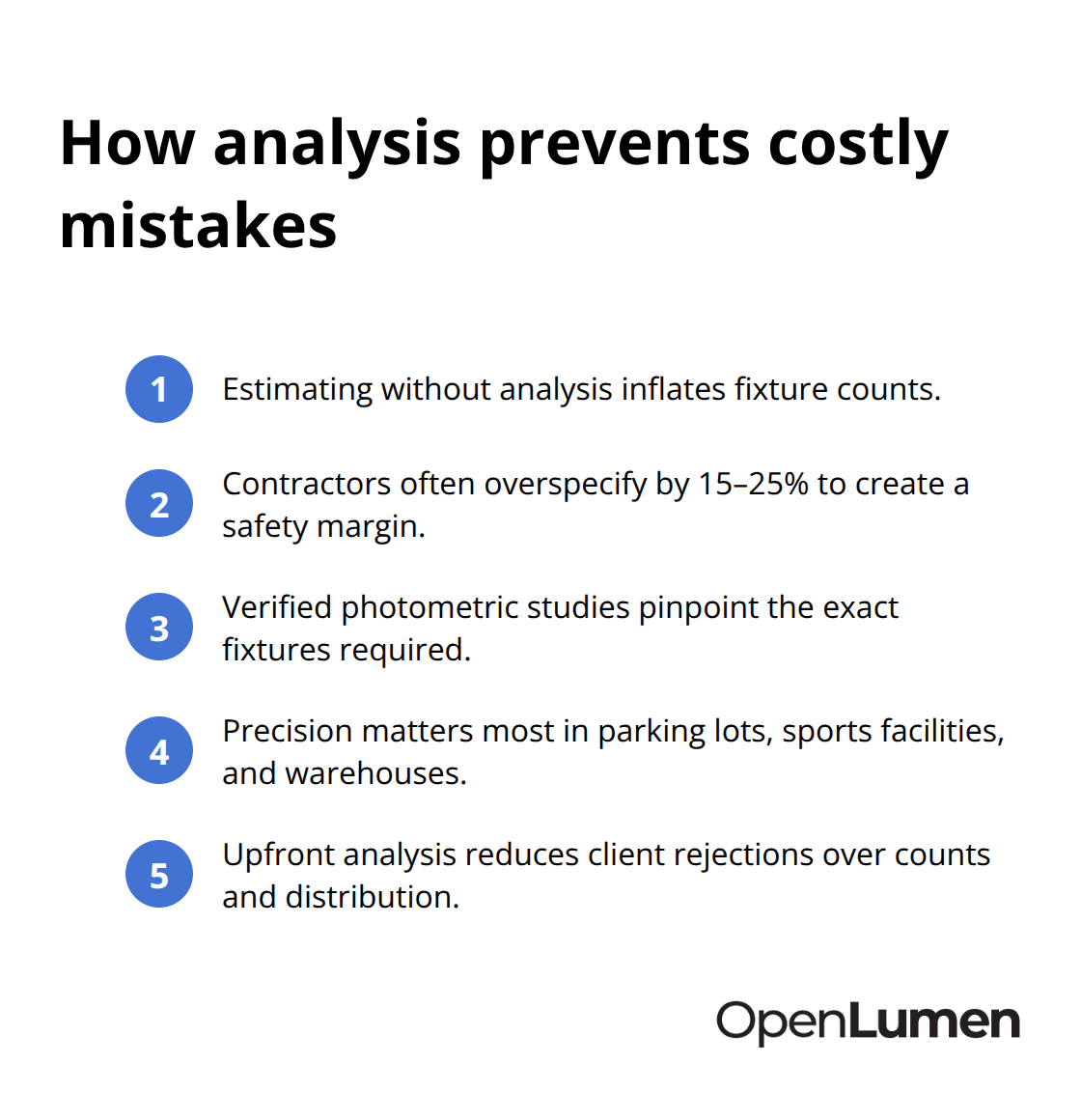
Analysis before purchase prevents the scenario where a client rejects your proposal because the quoted fixture count seems excessive or the predicted light distribution looks uneven in renderings.
Verified Luminaire Data Stops Design Errors Before They Start
Manufacturer specifications vary widely, and relying on generic product sheets introduces uncertainty into your calculations. Verified luminaire data-including polar charts, beam angles, and lumen output under real conditions-removes that guesswork. When you use tested, community-verified luminaire libraries in your analysis, your calculations match what actually gets installed. Projects using standardized photometric databases from reputable sources experience fewer performance gaps between predictions and real-world results. The difference shows up in client satisfaction: a design validated with accurate luminaire data builds confidence because clients see professional renderings that match the final outcome.
Professional Reports Close Sales Faster
Clients trust numbers they can see. A photometric report that includes target-point footcandles, average illuminance across the property, and visual renderings of the lighting outcome speaks louder than verbal estimates. These reports demonstrate compliance with code requirements-whether that means meeting minimum light levels for safety or staying within maximum levels to prevent light trespass on neighboring properties. Contractors who present verified photometric data report faster approvals and fewer scope changes during construction. The report becomes your contract: it shows exactly what the client pays for and what they’ll receive. Once you have this foundation in place, the next step involves selecting the right luminaires and positioning them strategically to achieve even light distribution across your entire project.
Building Layouts That Match Real-World Performance
Select Luminaires with Verified Performance Data
Selecting luminaires without understanding how they perform in your specific space leads to designs that fail inspection or disappoint clients. Start by defining your target illuminance levels based on the space type and applicable codes. A parking lot typically needs 0.5 to 1.5 footcandles average, while a sports facility like a baseball field demands 50 to 150 footcandles depending on the level of play. Once you know your target, choose luminaires with verified photometric data that includes polar charts showing light distribution patterns, color temperature ratings, and beam angles. Generic product brochures won’t tell you how a fixture actually performs at different mounting heights or angles, but verified luminaire data will. Community-verified luminaires libraries eliminate the uncertainty that comes from relying on manufacturer claims alone.
Space Fixtures to Prevent Dark Zones
The spacing between fixtures matters as much as the fixtures themselves. Luminaires spaced too far apart create dark zones and uneven illumination that fail code compliance and look unprofessional in renderings. Try spacing fixtures so that the distance between adjacent poles doesn’t exceed three times the mounting height. For a 20-foot pole, that means fixtures shouldn’t be more than 60 feet apart. However, this varies based on the luminaire’s beam angle and light distribution.
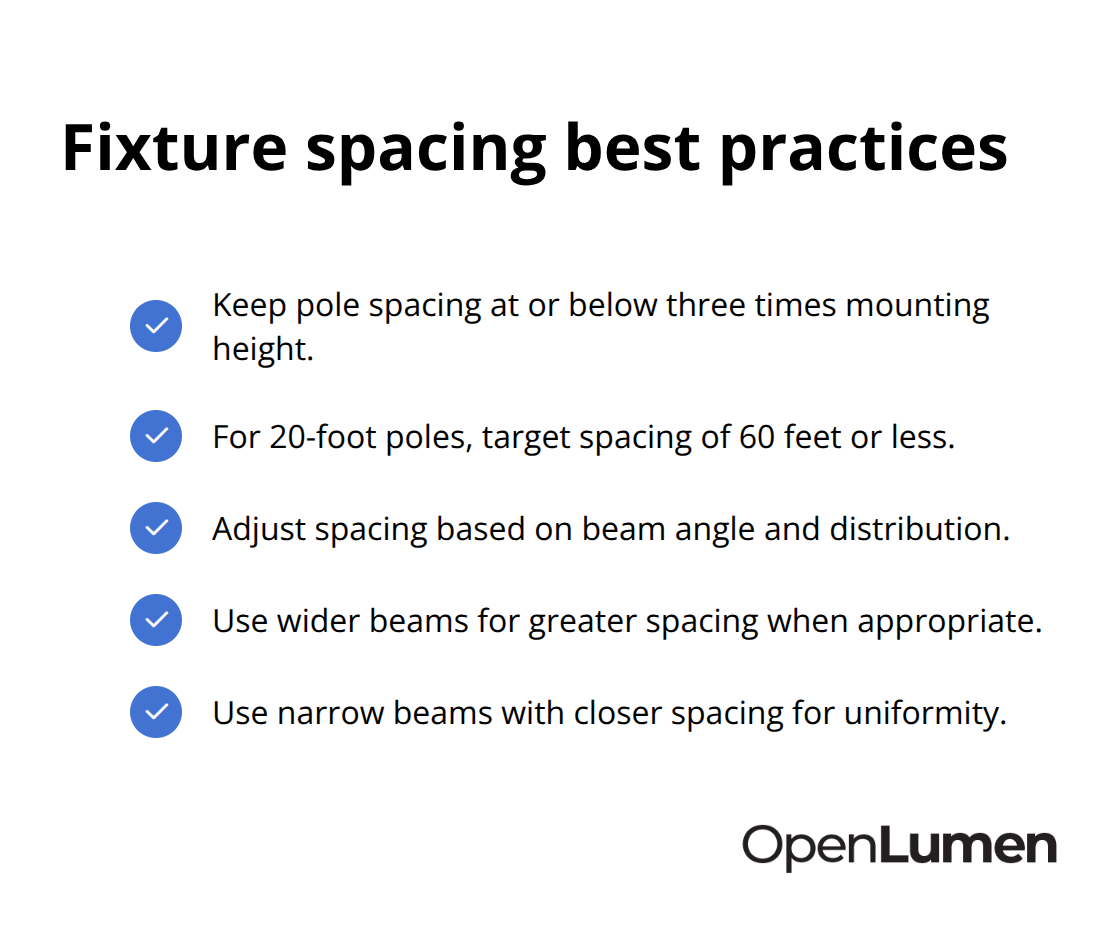
Wider beam angles allow greater spacing, while narrow beams require closer placement.
Validate Layouts with Real-Time Analysis
Running real-time analysis before finalizing your layout prevents expensive mistakes. Most contractors still sketch layouts on paper or use spreadsheets, then hope the design works when installed. That approach wastes weeks and invites costly changes. Real-time photometric analysis shows you exactly where light levels fall short or exceed your targets. If your initial spacing leaves a dark zone in the middle of a parking lot, you adjust the layout instantly and see the updated illuminance map within minutes. This iteration cycle during design saves far more time than it takes to run.
Prove Compliance Before Construction Begins
The analysis also reveals whether your design complies with light trespass limits, which many jurisdictions enforce at property lines. A rendering that shows zero footcandles beyond the property boundary proves compliance before construction begins, eliminating post-installation disputes with neighbors or code officials. Teams that validate layouts with real-time analysis close proposals faster because they present clients with verified solutions rather than educated guesses. Once you’ve validated your layout and confirmed compliance, the next step involves generating the professional reports and metrics that turn your technical analysis into a persuasive sales tool.
How to Turn Technical Analysis Into Winning Proposals
Translate Analysis Into Visual Proof
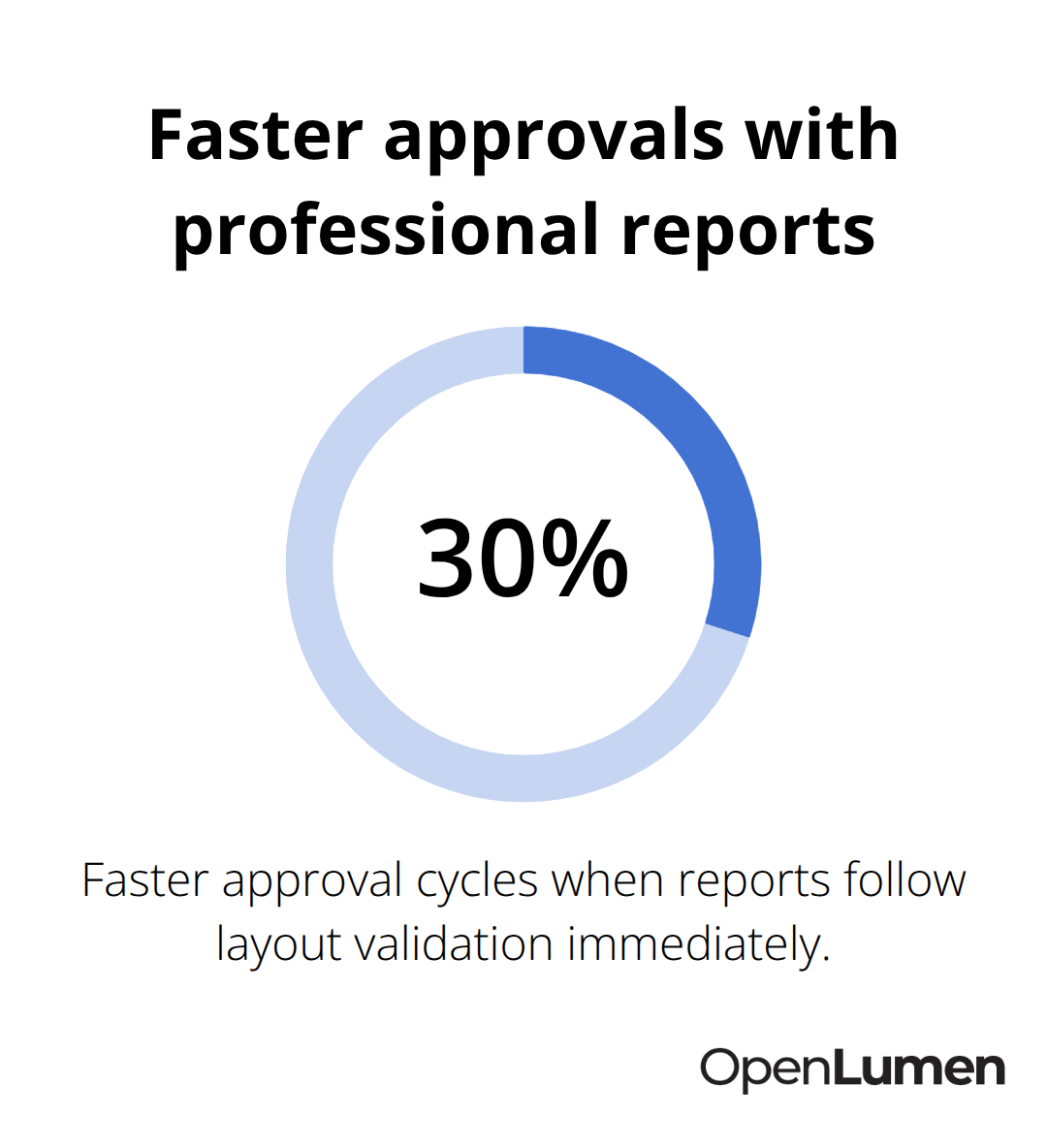
Photometric analysis means nothing if you can’t communicate it to clients in a way that drives decisions. The gap between what you know about your design and what clients understand is where proposals fail or stall. Professional reports bridge that gap by translating illuminance calculations, fixture counts, and compliance data into visual and numerical proof that your solution works. A rendered image showing exactly how the parking lot will look under your proposed lighting, paired with footcandle measurements at key points and a compliance checklist, removes doubt from the client’s mind. Contractors who generate these reports immediately after validating their layout report 30% faster approval cycles compared to those who email sketches and verbal estimates.
Make Your Report Your Contract
The report becomes your contract document-it specifies exactly what fixtures go where, what light levels result, and how the design meets code requirements. This eliminates scope creep because the client sees the precise outcome before construction begins. A professional photometric report gives you a concrete reason to quote a specific number of luminaires rather than a vague range, which builds credibility and prevents clients from shopping your design to a cheaper competitor who hasn’t done the analysis.
Compare Multiple Options in Hours, Not Days
Speed matters in sales, and comparing design options fast gives you a competitive edge. Instead of spending three days modeling one layout, then another three days modeling an alternative with different fixture types or spacing, real-time analysis lets you test multiple scenarios in hours. Adjust spacing, swap in a more efficient luminaire, or shift pole positions to avoid obstructions-and see the updated illuminance map and energy projections within minutes. This capability transforms how you sell.
Win Decisions With Side-by-Side Comparisons
A client asks whether LED luminaire type A or type B makes more sense for their warehouse, and you model both options on the spot, showing side-by-side comparisons of light distribution, average illuminance, and annual energy cost. The client sees hard data proving one option delivers better light quality at lower cost, which accelerates the decision. Teams that present multiple validated options close deals faster because clients feel confident they’ve chosen the best solution, not just accepted the first proposal.
Protect Your Margins With Verified Data
The ability to iterate and compare also protects your margins-when you can prove that a slightly higher fixture count delivers code compliance and better light quality than a cheaper, sparse layout, clients accept the higher bid because they understand the value. This advantage disappears if you rely on estimates, because competitors can always undercut with lower numbers that nobody has actually verified.
Final Thoughts
Commercial photometric layouts stop being optional the moment you realize how much time and money they save. Every contractor who still relies on estimates instead of verified data leaves money on the table through redesigns, client pushback, and lost deals. The projects that move fastest and close with the highest margins are the ones backed by real analysis and professional reports that clients trust.
Verified data transforms how you sell. Instead of defending a fixture count that seems high or explaining why your rendering looks different from competitors’ sketches, you present a photometric report that proves your solution meets code, delivers the right light levels, and costs less to operate. Clients stop negotiating on price because they understand the value, and they stop requesting changes mid-project because they approved a design validated before construction began. Speed compounds across your year-faster approvals mean more projects, higher team utilization, and better cash flow.
OpenLumen is a free, browser-based lighting platform that makes this workflow fast and accessible. The community-verified luminaires library removes the guesswork from fixture selection, and instant metrics give you the data you need to validate designs in minutes instead of days. Start your next project with verified data.
The information provided is for general educational purposes only and should not be considered professional engineering or lighting design advice. Always verify project requirements, local codes, and specifications with qualified professionals before making final decisions.