
Photometric data quality directly impacts whether your lighting designs work or fail. Bad data leads to wasted time, failed inspections, and expensive rework on job sites.
At OpenLumen, we’ve seen how a photometric data quality check catches problems before they become costly mistakes. Clean, consistent data is what separates successful projects from ones that derail.
Why Bad Data Breaks Lighting Projects
Data Errors Stop Projects Cold
Photometric data errors don’t just slow projects down-they stop them cold. When luminaire specifications are wrong, your illuminance calculations miss the mark, and site inspections reveal that your design never met the required light levels. Contractors then face the choice between expensive fixture swaps mid-project or rework that eats into margins. A single data error cascades through the entire workflow, from initial layout to final commissioning. Projects stall for weeks because a manufacturer’s file lists incorrect lumen output or color temperature, forcing teams to recalculate everything and reorder equipment. The cost isn’t just the rework-it’s the lost time, the client frustration, and the damage to your reputation when deadlines slip.
Safety and Compliance Failures
Inconsistent or unverified photometric data creates real safety and compliance headaches. Building codes require specific illuminance levels in stairwells, emergency exits, and work areas. If your design relies on photometric data that turns out to be inaccurate, your installation may fail inspection or leave occupants in inadequate lighting conditions. Worse, liability follows. A property owner faces regulatory fines and potential lawsuits if an accident occurs in poorly lit spaces because the lighting design was based on faulty data.
The Real Cost of Rework
Clean, verified photometric data eliminates these risks. When you work with standardized, peer-reviewed specifications, your designs stand up to inspection and your teams avoid costly callbacks. One major rework project costs 15-25% more than the original installation, and that’s before accounting for schedule penalties and lost future work. Investing time upfront to validate photometric data saves thousands in downstream corrections and protects your credibility with clients and building officials.
These problems compound when teams lack a reliable way to verify luminaire data before designs go to the field. The next section shows where these data problems originate and what specific steps you can take to catch them early.
Where Photometric Data Goes Wrong
Photometric data problems rarely announce themselves. They hide in manufacturer files, spread across incompatible formats, and accumulate as teams copy specifications from outdated sources. The three most destructive problems occur when file formats clash without clear metadata to explain what you’re looking at, when luminaire specs contradict each other across different sources, and when manufacturers update their products without flagging that old data is no longer valid. These aren’t edge cases-they’re routine obstacles that derail projects weekly across the industry.
Format Chaos and Missing Context
IES files, Excel spreadsheets, PDF spec sheets, and proprietary manufacturer formats all claim to describe the same luminaire, but they rarely agree on what the data means. One file lists lumens at 3000K color temperature while another provides output at 2700K without stating the temperature explicitly. A third source gives total lumens but doesn’t clarify whether that’s initial lumens or rated life lumens at 70% lumen maintenance. When you pull data from multiple vendors, you lose track of which version applies to which product.
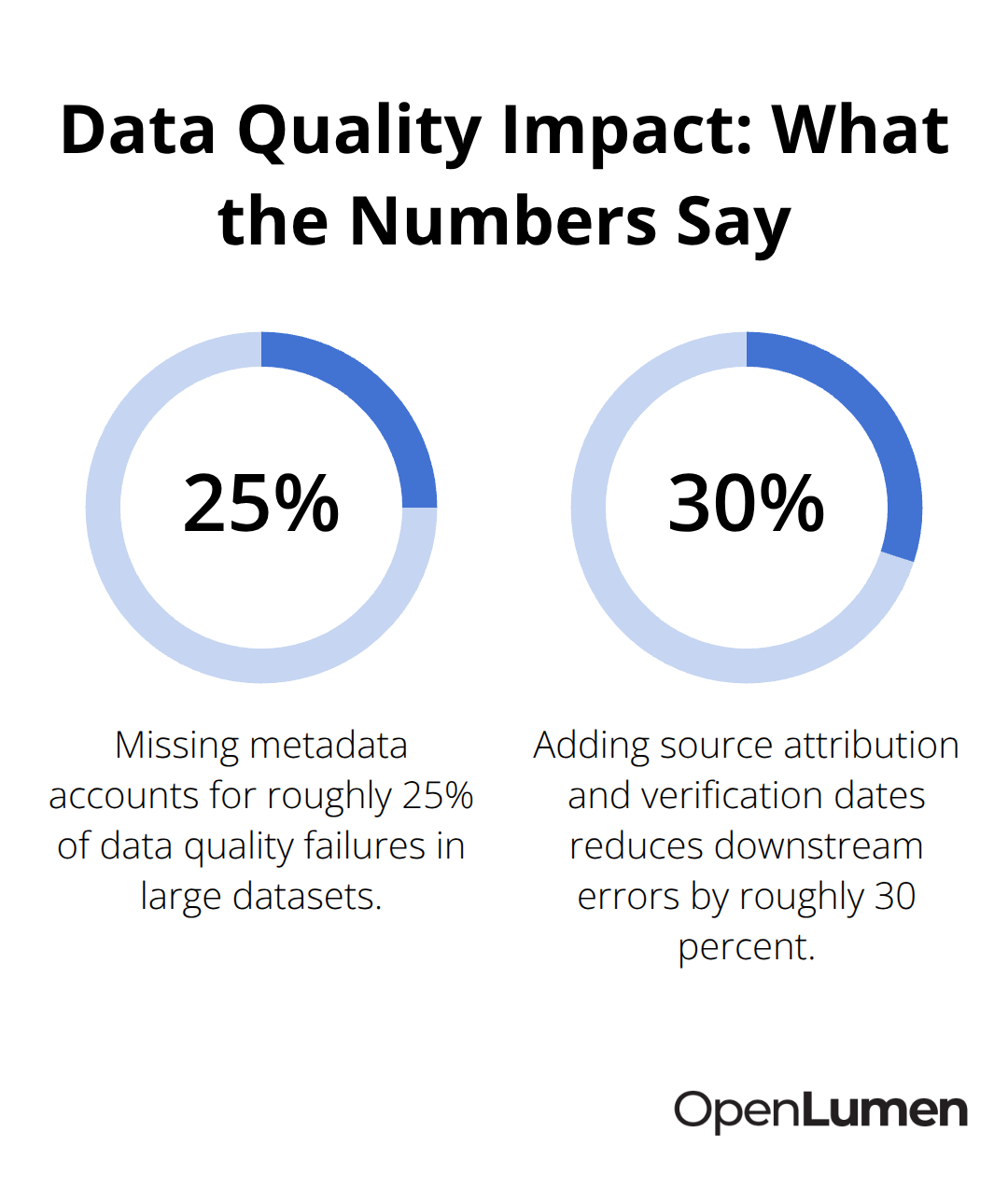
The real damage occurs during site adjustments. A contractor swaps a fixture mid-project, grabs specs from the nearest digital file, and discovers too late that the new luminaire has different output or beam distribution. Data validation experts report that missing metadata accounts for roughly 25% of data quality failures in large datasets. Without clear labeling of measurement conditions, color temperature, and lumen maintenance assumptions, teams make assumptions that turn into expensive mistakes.
Standardized metadata tagging prevents this chaos. Enforce consistent labeling before any photometric file enters your workflow-specify the color temperature, measurement standard, and lumen maintenance condition on every file. This single step eliminates most format-related errors before they reach the design phase.
Conflicting Specs and Unverified Claims
Manufacturers sometimes list different specifications for identical products across their website, dealer catalogs, and technical documentation. A linear fixture might show 120 lumens per foot on one page and 115 lumens per foot on another, with no explanation of the difference. Worse, some manufacturers don’t update older data when they release improved versions of existing products. You design around a 95 lumen per foot specification only to discover the current production model delivers 110 lumens per foot-meaning your spacing calculations were conservative but your cost estimates were wrong.
Third-party databases and distributor websites compound this problem by copying old specs without verification. The only reliable approach treats manufacturer data as provisional until you confirm it against multiple independent sources. Peer review catches these conflicts before they reach your design team. Outdated manufacturer information is the most insidious problem because it looks authoritative until a real installation reveals the gap between what you designed and what actually shows up on site.
Verification Against Multiple Sources
Cross-checking specifications against at least two independent sources catches most conflicting claims before they affect your project. When you find discrepancies, contact the manufacturer directly to confirm which specification applies to current production. Document the verification date and source on every luminaire record you use-this creates an audit trail that protects you if questions arise later.
Community-verified luminaire libraries reduce this burden significantly. These databases require peer review and multiple source confirmation before specifications enter the system, meaning you inherit the verification work that other designers have already completed. This approach shifts the verification load upstream, so your team spends less time chasing down conflicting specs and more time designing.
The next section shows the specific practices that prevent these data problems from taking root in your workflow.
How to Build a Data Verification System That Actually Works
The gap between knowing you need clean photometric data and actually maintaining it comes down to one thing: a verification system with teeth. Generic advice to standardize your processes won’t stop a contractor from grabbing an outdated spec sheet off a vendor website at 2 PM on a Friday. What works is a repeatable process that makes verified data the path of least resistance, paired with regular audits that catch drift before it costs you money.
Establish a Single Source of Truth
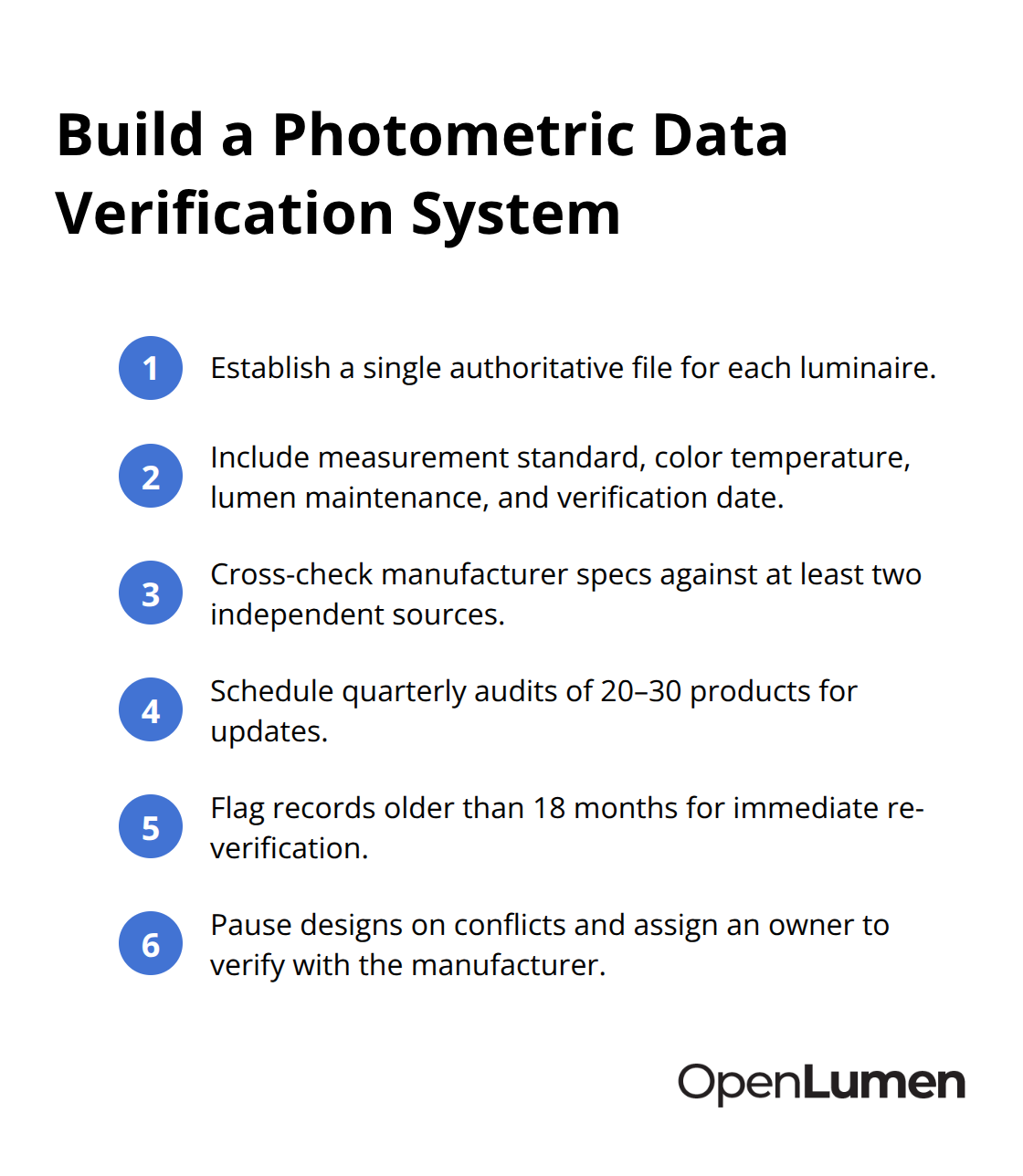
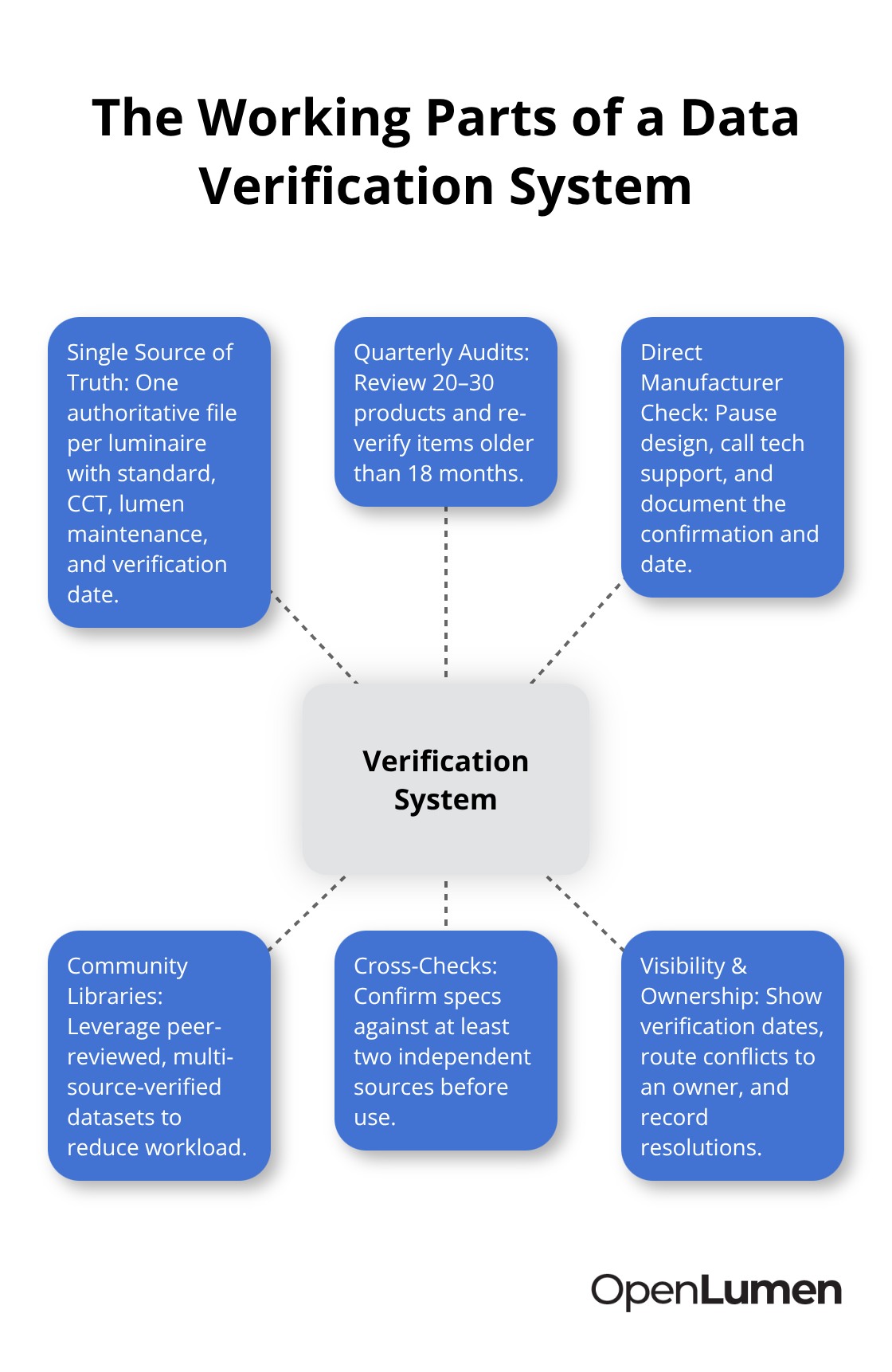
Start by establishing one authoritative file for every luminaire specification your team uses. This file must include the measurement standard (IES LM-79 or similar), the color temperature tested, the lumen maintenance assumption, and the verification date. When a team member needs a spec, they go to that file first. Every other source becomes a secondary reference for cross-checking only. This eliminates the scenario where someone pulls conflicting data from two different websites and picks whichever one fits their design assumptions.
Documentation matters more than most teams realize. Data validation research across industrial datasets shows that adding source attribution and verification dates to every specification reduces downstream errors by roughly 30 percent. The verification date tells you whether the data reflects current production or an older version. When you find conflicting specs during cross-checks, that date forces the conversation: Is this discrepancy because the manufacturer updated the product, or because one source never got refreshed?
Schedule Quarterly Audits and Verification
Schedule quarterly audits of your luminaire library. During each audit, pull a random sample of 20-30 products and verify their specifications against current manufacturer datasheets and at least one independent source like a distributor catalog or community database. Flag any specs that haven’t been verified in over 18 months for immediate re-verification. This cadence catches product updates and manufacturing changes before they reach your design team.
Community-verified luminaire libraries accelerate this process significantly. These platforms already handle the peer review and multi-source verification work. Instead of your team spending hours confirming that a linear fixture’s lumen output matches across three different sources, you inherit that verification from designers who completed it months ago. The platform flags when specifications become outdated or when multiple sources disagree. Your role becomes auditing the library quarterly and confirming that the products you use most frequently still match current production.
Handle Conflicting Data With Direct Verification
Train your team on what to do when they encounter conflicting data. The instinct is often to pick the specification that fits the design, but that’s backwards. When specs conflict, the design pauses until verification happens. Contact the manufacturer’s technical support line directly. Ask which specification applies to current production and request a current datasheet as proof. Document that contact and response in your luminaire records. This approach takes an extra 30 minutes per conflict but prevents weeks of rework downstream.
Make verification a visible part of your workflow, not a hidden backstage task. When a designer pulls a luminaire spec, show them the verification date and source. When someone flags conflicting information, route it to a single person who owns verification and documents the resolution. This visibility creates accountability and makes data quality a shared responsibility rather than something that falls through cracks.
Calculate the Real ROI of Data Verification
The cost of maintaining this system is trivial compared to the cost of a single rework project. One major installation that fails inspection due to faulty photometric data costs 15-25 percent more than the original installation. A quarterly audit of 20-30 products takes roughly 4-6 hours per quarter. That’s less than two days of work annually to protect yourself against errors that could cost tens of thousands of dollars. The math is straightforward: invest a small amount of time upfront to verify data, or spend far more time and money fixing failures downstream.
Final Thoughts
Clean photometric data forms the foundation that separates lighting designs that work from ones that fail on site. Every hour you invest in verifying specifications, standardizing formats, and auditing your luminaire library pays back tenfold when inspections pass on the first attempt and contractors avoid mid-project fixture swaps. The photometric data quality check process requires discipline, but it’s straightforward: establish one authoritative source for every luminaire, schedule quarterly audits, and train your team to pause when specs conflict instead of guessing which number is correct.
A single rework project costs 15-25 percent more than the original installation, plus schedule penalties and reputation damage. Spending 4-6 hours per quarter on data verification costs far less than recovering from one failed design. Teams that maintain clean, consistent photometric data also move faster through the design-to-install workflow because they spend less time troubleshooting conflicts and more time creating layouts that work.
Tools like OpenLumen provide community-verified luminaire libraries that inherit peer review and multi-source verification from other designers, eliminating the burden of confirming every specification yourself. Real-time illuminance analysis and instant photometric metrics let you validate designs before they reach the field, catching errors when they’re still cheap to fix. Start today by auditing your current luminaire library, flagging specifications that lack verification dates, and contacting manufacturers for current datasheets on your most-used products.
The information provided is for general educational purposes only and should not be considered professional engineering or lighting design advice. Always verify project requirements, local codes, and specifications with qualified professionals before making final decisions.