Miscommunication on lighting projects costs time and money. When teams, clients, and contractors work from different versions of specifications or incomplete information, approvals stall and disputes emerge.
Standardized design reports fix this. At OpenLumen, we’ve seen how consistent documentation transforms project delivery-reducing back-and-forth, speeding decisions, and building confidence across all stakeholders.
Why Standardized Reports Stop Project Delays
Unclear specifications create friction at every stage. When electrical contractors, lighting designers, and project managers reference different versions of plans or incomplete technical data, approvals slow down and costs climb. Standardized reporting directly reduces back-and-forth cycles by establishing a single source of truth for all teams. Teams who face this constantly-contractors bidding on vague specs, designers uncertain whether their intent made it into final documents, and owners waiting weeks for answers that should take days-know the cost of miscommunication firsthand.
Faster Decisions When Everyone Reads the Same Page
Standardized reports cut decision time significantly because stakeholders don’t need to request clarifications or hunt for missing information. When a design report includes performance metrics, compliance verification, and technical specifications in a predictable format, approvers move forward confidently. Property owners and facility managers make decisions faster when reports present energy targets, lighting levels, and compliance data clearly rather than scattered across multiple documents. Contractors accelerate their work when they know exactly which luminaires the specification calls for, where occupancy sensors must be positioned, and which color temperatures apply to each space. The Global Reporting Initiative found that standardized disclosure formats improve stakeholder understanding and reduce the time needed to assess project readiness.
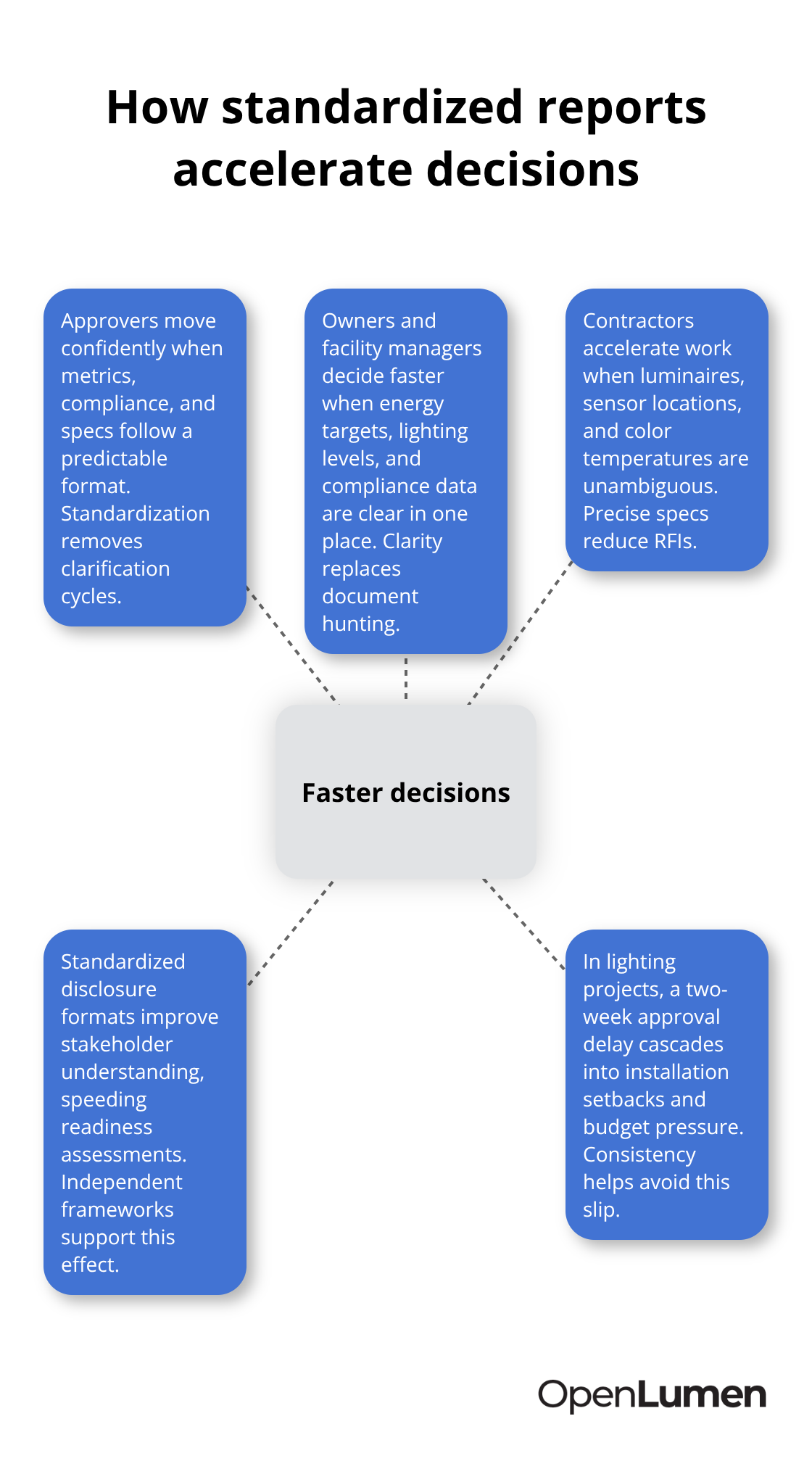
This matters in lighting projects where a two-week delay in approval cascades into installation delays and pushes budgets higher.
Trust Grows When Documentation Proves Your Decisions
Stakeholders trust teams that document their reasoning. A standardized report that ties lighting choices to codes, performance goals, and owner requirements demonstrates professionalism and accountability. When you show that a 500 lux specification in a warehouse meets ASHRAE 90.1 energy-code requirements and supports worker safety, stakeholders see competence, not guesswork. Clients and facility owners gain confidence knowing that design decisions rest on documented criteria rather than assumptions. Contractors reduce their risk when design reports clearly state responsibilities, maintenance expectations, and warranty terms-eliminating disputes about who owns what after installation. This transparency strengthens relationships because all parties understand the project’s intent from the start, not after problems emerge on site.
What Goes Into a Report That Actually Works
The next step is identifying what content transforms a report from a collection of drawings into a decision-making tool. The right structure-one that includes project overview, technical specifications, visual documentation, and compliance verification-ensures that every stakeholder finds what they need without wading through irrelevant details.
What Belongs in Your Design Report
A standardized design report needs five core elements working together, not scattered across separate documents. Start with the project overview, which states the owner’s goals, energy targets, space-use requirements, and budget constraints from the Owner’s Project Requirements. This section anchors everything that follows-without it, stakeholders won’t understand why certain lighting choices were made.
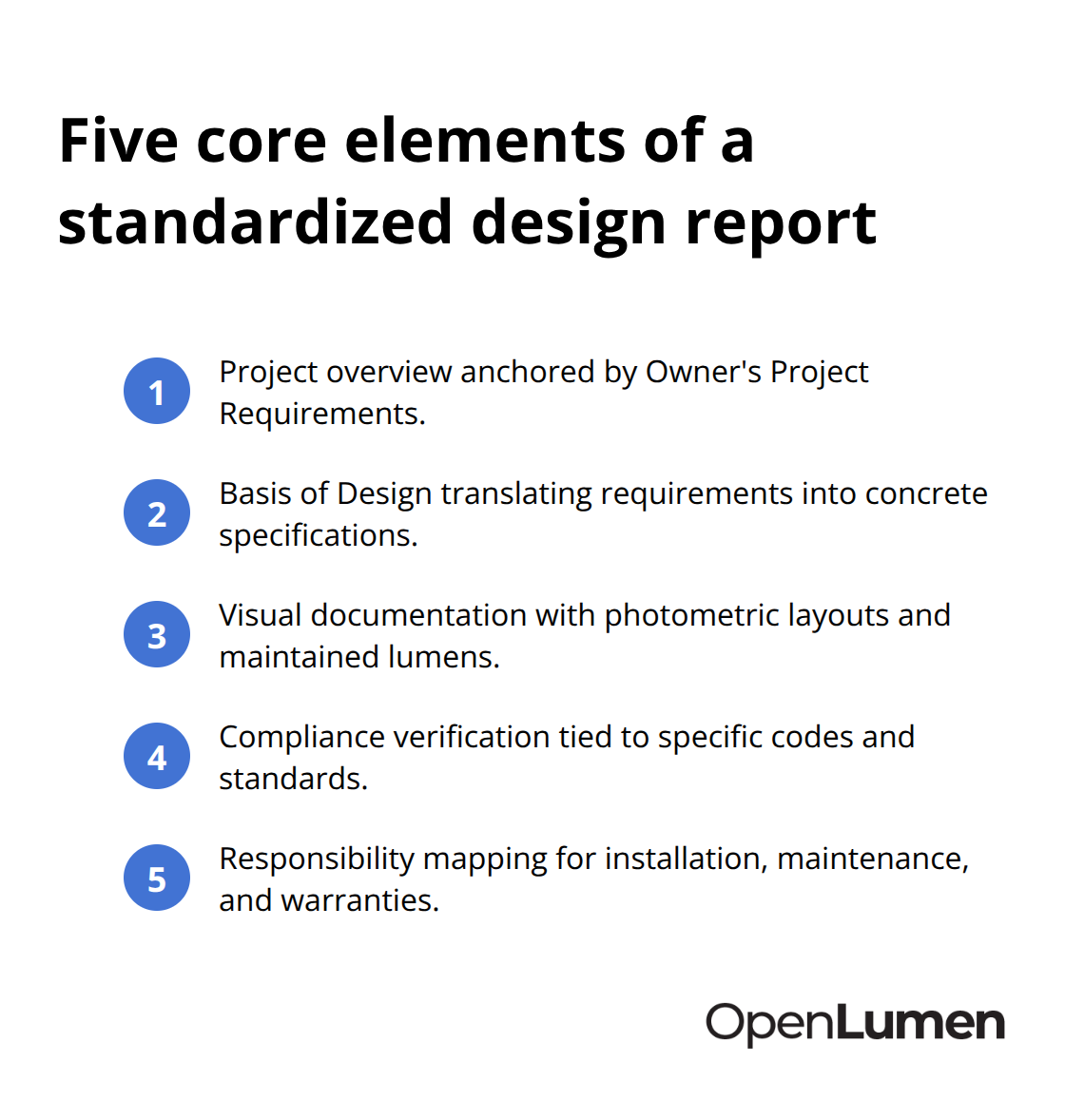
Next, include the Basis of Design, which translates those requirements into concrete specifications: lighting levels per space in maintained lumens, color temperature ranges, energy-code baseline (such as ASHRAE 90.1 or IECC), occupancy sensor placement rules, and maintenance expectations. The report must reference the specific energy code the project follows, because mismatches between the code baseline and design documentation cause permitting delays and rework.
Visual Documentation That Contractors Can Build From
Visual documentation comes third-photometric layouts show fixture locations, illuminance maps prove compliance with lighting levels, and technical drawings contractors can build from without guessing. Use maintained lumens from fixture data rather than initial lumens when modeling, because initial lumen claims don’t reflect real-world performance after the first 40 hours of operation. Accurate photometric data prevents costly field corrections and ensures contractors bid correctly on the actual design intent, not assumptions about what the drawings might mean.
Performance Metrics and Compliance Verification
Performance metrics form the fourth pillar: energy consumption in kilowatt-hours, annual operating costs, ROI calculations, and lifecycle-cost analysis comparing upfront expenses against long-term maintenance labor and replacement cycles. Include compliance verification explicitly, showing how the design meets applicable codes-NEC Article 110.26(D) for electrical rooms, LEED Fundamental Commissioning requirements if applicable, and local lighting ordinances that restrict light trespass. This documentation protects the project from permitting delays and gives stakeholders confidence that the design will pass inspection.
Responsibility Mapping and Maintenance Planning
The fifth element, often overlooked, is responsibility mapping: clearly state who installs what, who maintains sensors and controls, what warranty terms apply, and what training the owner’s staff receives. This prevents disputes after handoff and ensures facility managers know exactly how to operate the lighting system once contractors leave the site.
Template Structure That Reduces Questions
The format matters as much as the content. Use a standardized template across all projects so stakeholders instantly know where to find information. Include a table of contents, a stakeholder register identifying who receives which sections, and an auditable log linking design decisions back to owner feedback and code requirements. Attach relevant past communications-emails, meeting minutes, OPR documents-to provide context and continuity. When referencing standards, cite high-authority sources like ASHRAE, the DOE Building Energy Codes Program, NEC, and the IES Lighting Handbook so reviewers can verify your work without follow-up calls. A well-structured report reduces questions because it answers them proactively, saves contractors time during bidding because specifications are complete, and protects everyone legally because decisions rest on documented evidence.
With the right content and structure in place, the next challenge is actually producing these reports consistently across multiple projects without consuming your team’s time on manual formatting and data entry.
Building Reports Your Team Will Actually Use
Standardized templates work only if your team uses them consistently, which means the template must be simple enough that busy contractors and designers adopt it instead of reverting to old habits. Start with a single master template in a format your entire team already uses-Google Docs, Word, or a shared project management platform-not a tool that requires training or software licenses nobody has. The template should mirror the structure outlined earlier: Owner’s Project Requirements summary, Basis of Design with explicit energy-code baseline, photometric layouts with maintained lumens data, compliance verification tied to specific code sections, and responsibility mapping. Assign one person to own the template and update it quarterly based on feedback from contractors and designers who actually fill it out. This person catches gaps-missing luminaire data, unclear responsibility statements, incomplete compliance sections-before reports reach clients.
Automate Data Entry to Eliminate Manual Errors
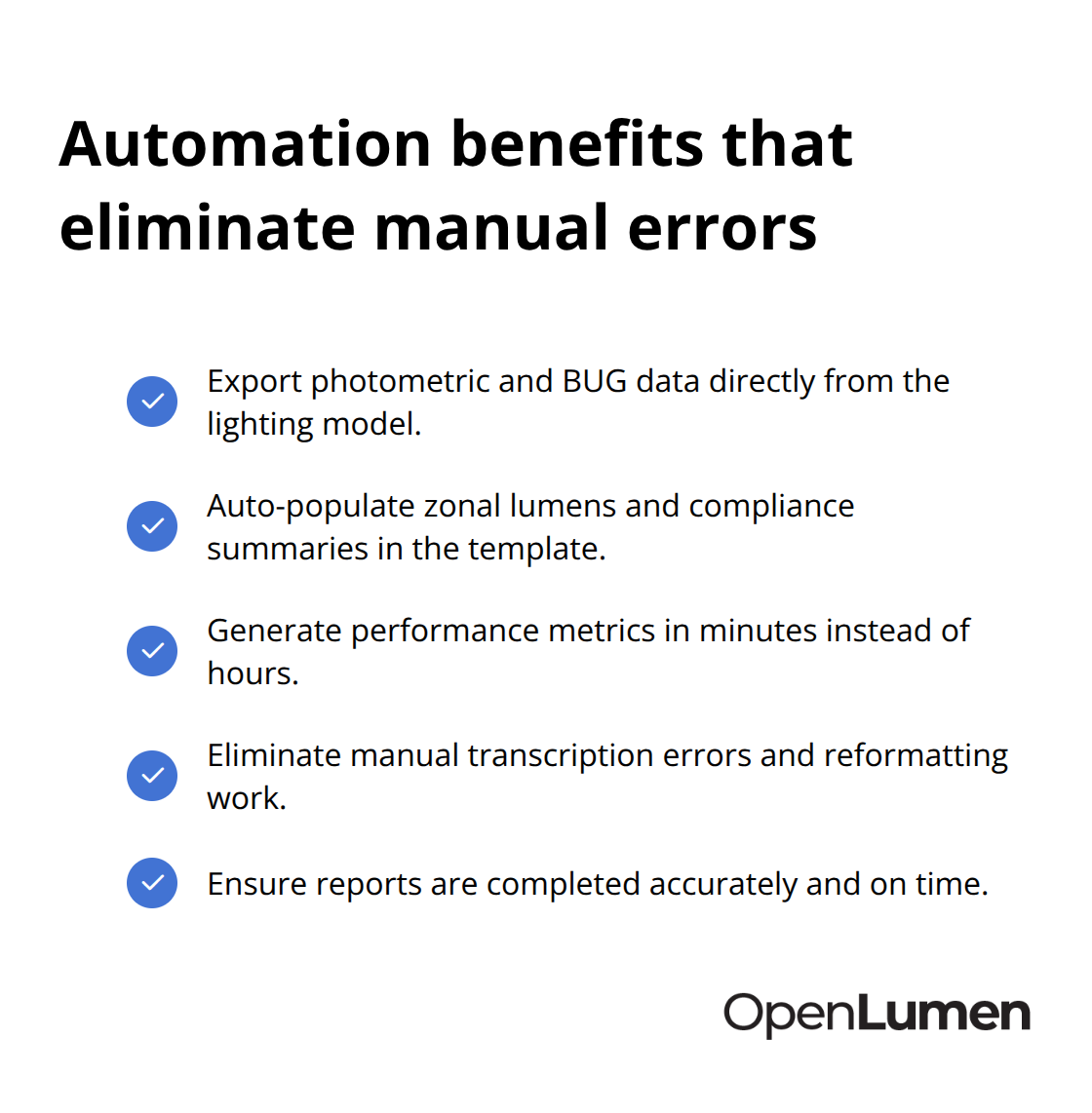
Automation transforms standardized reporting from a compliance checkbox into a competitive advantage. Use your design tool’s export functions to populate sections of the report automatically-photometric data, BUG ratings, zonal lumen calculations, and compliance summaries all pull directly from your lighting model rather than being retyped or copied manually. Set up a simple workflow where a designer completes the lighting layout, exports the data, and the template automatically generates the performance-metrics section, cutting report-assembly time from hours to minutes. When design tools connect directly to your reporting template, data flows without manual transcription errors and reduces the time spent reformatting numbers. Templates that require manual data entry get skipped or filled incorrectly; templates that pull real data from design tools get completed on time and accurately.
Distribute Responsibilities Across Your Team
Train your team on three specific responsibilities: the designer documents the Owner’s Project Requirements and Basis of Design before any luminaires are selected, the lighting technician verifies that photometric data and code references are complete and accurate, and the project manager reviews the final report against a checklist before it reaches the client. This division prevents bottlenecks where one person becomes the reporting expert everyone else depends on. Rotate report responsibilities quarterly so knowledge spreads across the team instead of concentrating in one person’s hands. Teams that distribute responsibilities recover faster when someone takes vacation and avoid the situation where critical reports stall because one person is unavailable.
Final Thoughts
Standardized design reports transform how teams communicate on lighting projects. When your documentation follows a consistent structure-Owner’s Project Requirements, Basis of Design, photometric layouts, compliance verification, and responsibility mapping-stakeholders move from confusion to confidence. Approvals accelerate because everyone reads the same specifications, contractors bid accurately instead of guessing at intent, and facility managers understand how to operate their lighting systems after installation.
The cost of inconsistent reporting appears immediately through delayed approvals, bidding errors, installation rework, and strained client relationships. Your team spends less time answering clarification questions when standardized design reports establish a single source of truth. Projects move through permitting faster because compliance documentation is complete and accurate from the start, and clients trust your work because you demonstrate competence through clear, professional communication.
Implementation requires no expensive new software or complex processes-start with a single template your team already uses and automate data entry so photometric calculations and compliance summaries pull directly from your design work. Tools like OpenLumen streamline this workflow by letting you generate professional reports directly from your photometric layouts, eliminating manual formatting and data-entry errors that consume hours each week.
The information provided is for general educational purposes only and should not be considered professional engineering or lighting design advice. Always verify project requirements, local codes, and specifications with qualified professionals before making final decisions.