Specification errors in lighting projects waste time and money. A single wrong lumen value or polar chart can derail an entire design, forcing contractors and designers back to square one.
At OpenLumen, we see this problem constantly. Luminaires data verification isn’t optional-it’s the foundation of every successful project.
Why Accurate Data Changes Everything
The Real Cost of Wrong Specifications
Wrong luminaire data breaks projects. A contractor specifies a fixture expecting 3,500 lumens but receives one rated at 2,800 lumens. The space falls short on illuminance. The client complains.
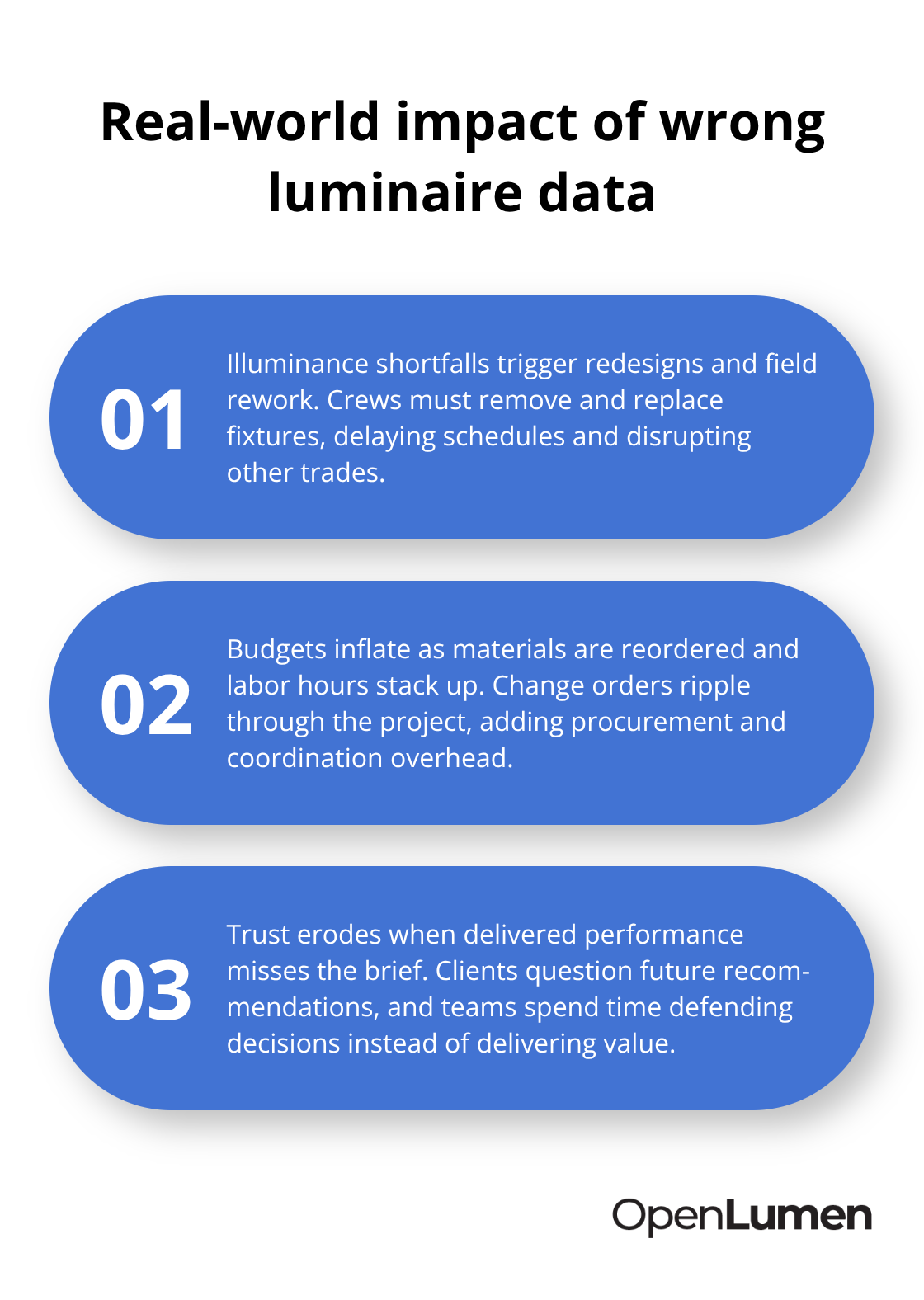
Work crews return to reinstall different fixtures. That’s wasted labor, materials, and reputation damage that could have been prevented with verified data from the start.
Specification errors in lighting projects waste time and money across the entire supply chain. A single wrong lumen value or polar chart forces designers and contractors back to square one, extending timelines and inflating budgets.
Where Data Goes Wrong
Luminaire manufacturers publish data in inconsistent formats, update specs without clear version control, and sometimes list LED module performance instead of actual fixture performance. Designers and contractors inherit this mess and have no fast way to validate what’s accurate.
A contractor selects fixtures for a warehouse renovation and pulls photometric data from one source, then discovers the polar chart doesn’t match the manufacturer’s latest release. Electrical specs don’t align with energy consumption claims. Lumen maintenance projections lack clarity on test conditions. Meanwhile, design software contains outdated product libraries that haven’t been refreshed in years. These aren’t rare edge cases-they’re systemic problems that derail timelines and inflate costs across the industry.
How Verified Data Protects Your Projects
Teams that demand cross-referenced photometric test reports from ISO/IEC 17025-accredited labs, confirm color characteristics against actual manufacturing samples, and validate lumen output against real-world conditions finish projects on schedule and within budget. Those that don’t end up managing failures, change orders, and frustrated clients.
The industry needs verified, traceable, and current luminaire data-not marketing numbers or incomplete specifications. This foundation determines whether your next project runs smoothly or stalls under the weight of conflicting information and hidden errors.
How to Verify Luminaires Data
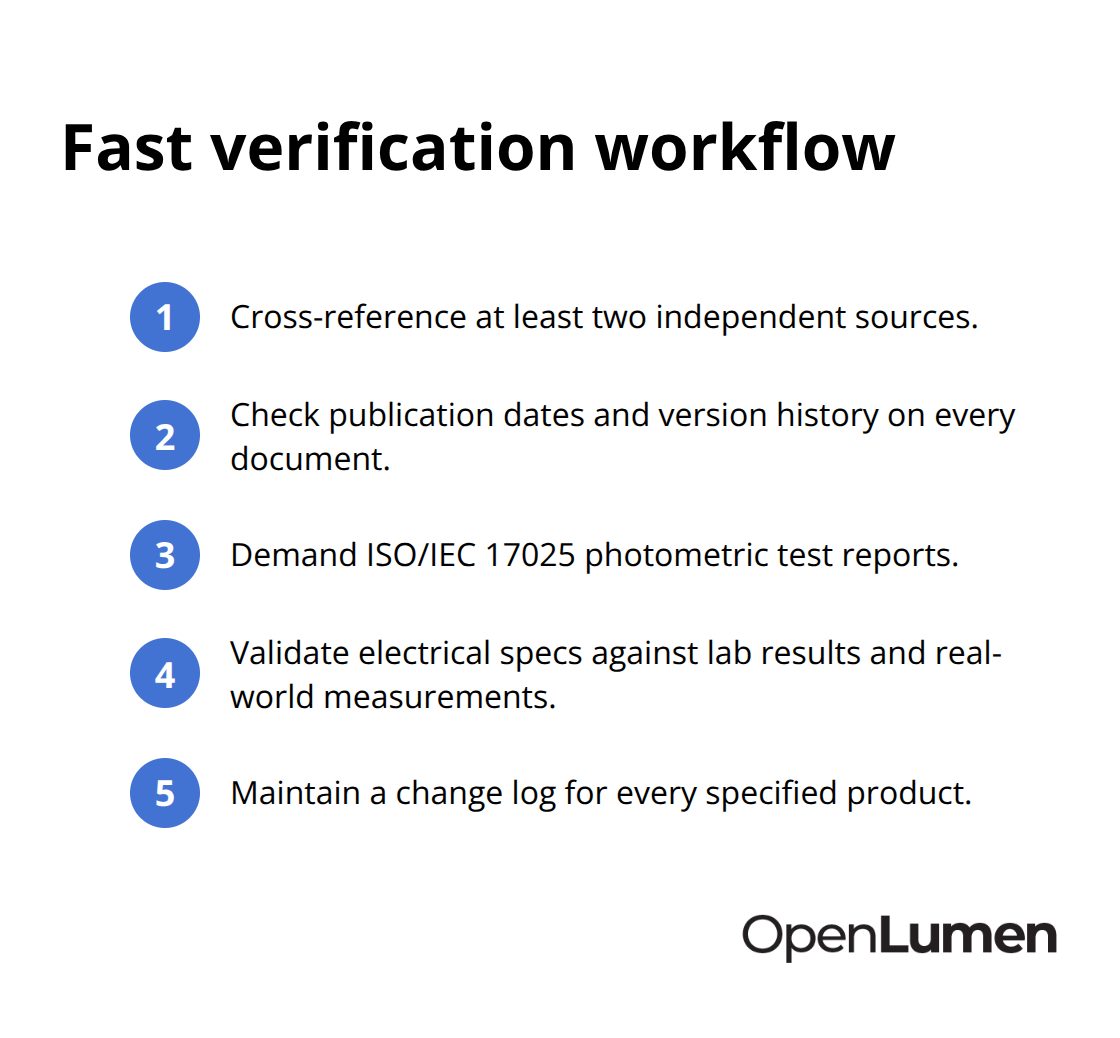
Cross-Reference Multiple Sources
Start with manufacturer datasheets, but never stop there. Pull specifications from at least two independent sources-the manufacturer’s website, their technical documentation, and third-party databases. If the lumen values, color temperature, or efficacy numbers differ between sources, that’s your first red flag. Manufacturers often update specs without clear version control, so check the publication date on every document. A datasheet from 2022 won’t reflect current production runs or corrected test data.
Demand Photometric Test Reports
ISO/IEC 17025-accredited labs conduct photometric testing under standardized conditions, and their reports include critical details: test temperature, sample ID, measurement uncertainty, and the actual equipment used. Demand these reports before you specify fixtures. Polar charts tell you light distribution, but inconsistent charts across platforms indicate either outdated data or measurement errors. Cross-reference the polar chart against the zonal lumen breakdown-if a fixture claims even light distribution but the polar chart shows hot spots, something’s wrong.
Color characteristics matter equally. Verify that stated CCT and CRI values match actual manufacturing samples, not just LED module data. Many manufacturers publish LED component specs rather than complete luminaire performance, which masks how drivers, heat sinks, and optics affect real-world output. Check the test report’s sample size too. A single unit tested doesn’t represent production consistency. Reputable labs test multiple samples and report variation across the batch.
Validate Electrical and Lifetime Data
Electrical specifications demand the same rigor. Verify rated wattage, voltage, current, and power factor align with energy consumption claims. A fixture claiming 50-watt consumption but drawing 62 watts in testing indicates either measurement error or misleading marketing. Lumen maintenance data-typically expressed as L70 or L90 at a specified number of hours-should reference both the test method and the extrapolation model used. IEC standards define how this data should be reported, but compliance varies widely.
Fixtures claiming 100,000-hour lifespans without supporting LM-80 test data or credible extrapolation deserve skepticism. Average installation life for indoor spaces runs around 50,000 hours according to typical design practices, so lifetime claims should match realistic operating conditions rather than laboratory maximums.
Use Community-Verified Libraries
Community-verified luminaire libraries eliminate guesswork by collecting tested data in one searchable location. These platforms cross-reference manufacturer claims against independent test results and flag discrepancies automatically. When you select a fixture in such a library, you pull data that’s been validated against photometric test reports and manufacturing documentation. This approach cuts verification time from hours to minutes and surfaces problems before they reach the job site.
Maintain a change log for every product you specify, noting when specifications were last updated and what changed. This practice prevents the common scenario where older design files reference obsolete luminaire data that no longer matches current production. When a manufacturer releases corrected specs, knowing your previous baseline prevents costly rework during installation. These verification habits form the backbone of reliable project execution-and they expose the data problems that derail timelines and inflate budgets across the industry.
Where Luminaire Data Falls Apart in Practice
Mismatched Data Across Platforms
Polar charts don’t match between the manufacturer’s website and design software. Zonal lumen breakdowns appear in one source but vanish in another. A fixture you specified six months ago now shows different electrical ratings in the current product library. These aren’t edge cases-they’re everyday obstacles that force designers and contractors to stop work and hunt for answers.
The problem stems from how data flows through the industry. Manufacturers update specifications without version control, design software vendors lag months behind in refreshing product libraries, and third-party databases pull from multiple sources that aren’t synchronized. A contractor pulls a polar chart from a luminaire manufacturer’s 2024 datasheet, imports it into design software that cached the 2022 version, and discovers the light distribution patterns don’t align.
Incomplete and Conflicting Specifications
The zonal lumen data-which breaks down light output by angle-appears complete in one platform but shows only partial information in another. Without the full zonal breakdown, you can’t accurately calculate illuminance at specific points in the space, forcing a restart of the entire photometric calculation.
Electrical specifications create similar chaos. One source lists a fixture at 60 watts with a power factor of 0.95, while another shows 62 watts at 0.92. That variance matters when you’re calculating demand loads for a large installation. Color characteristics suffer the same inconsistency. A manufacturer publishes CRI 90 for a luminaire, but the actual manufacturing samples test at CRI 87 because the datasheet reflects LED module performance, not the complete fixture with driver and optics. These gaps between published specs and real production create the foundation for field failures and change orders.
Verification Checkpoints That Stop Problems
Compare the publication date on every document you use-if design software shows a product from 2021 and the manufacturer released an updated version in 2024, pull the current datasheet before specifying. Cross-reference the polar chart against zonal lumen data by checking if the total lumens in the zonal breakdown match the claimed fixture output. If a 3,000-lumen fixture shows zonal lumens that only add up to 2,700, data corruption or measurement error occurred.
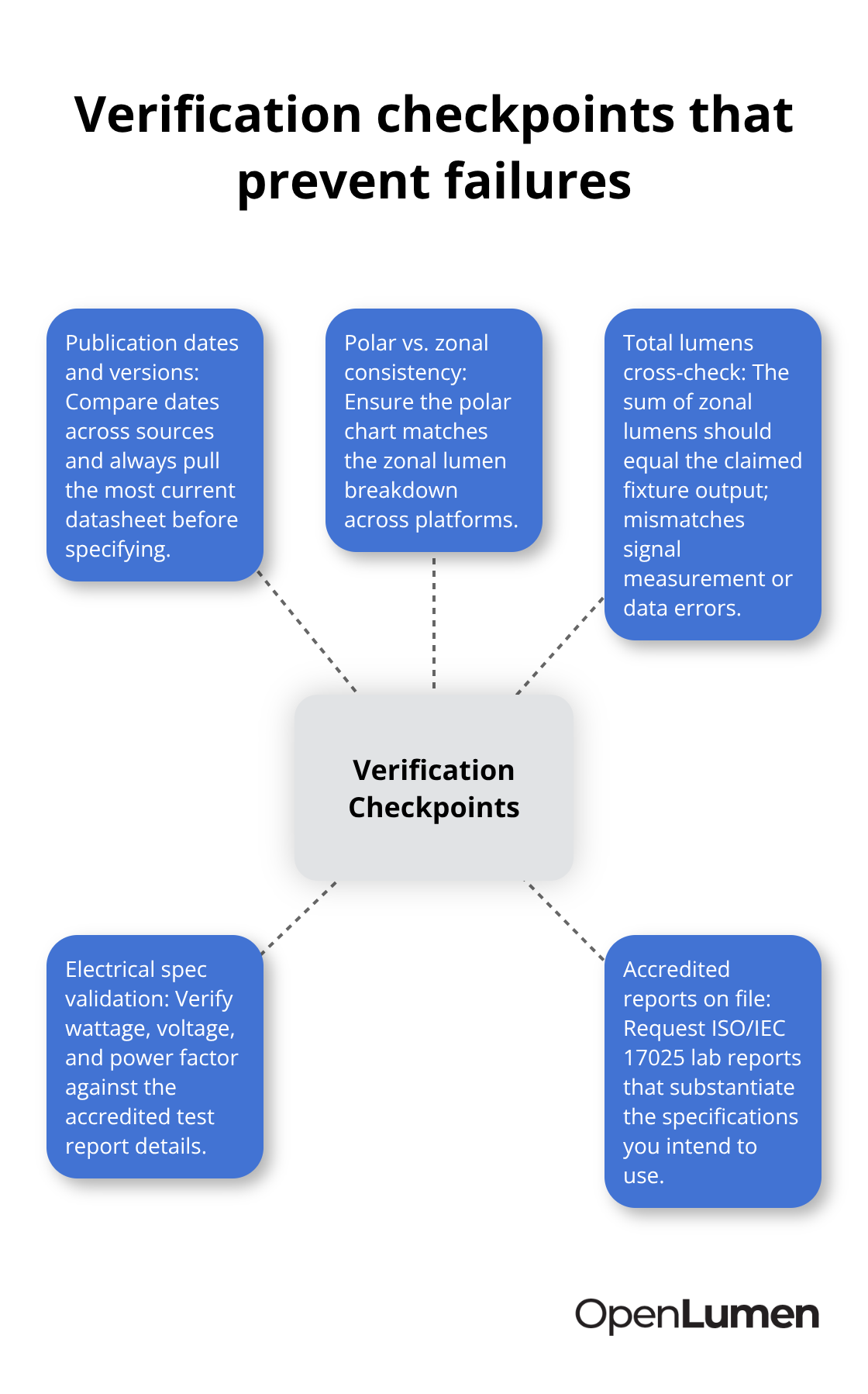
Verify electrical specifications against the photometric test report, which should state the exact wattage, voltage, and ambient temperature during testing. When manufacturers claim different wattages across sources, contact them directly and request the ISO/IEC 17025-accredited test report that supports the specification you plan to use.
Color and Temperature Validation
For color characteristics, demand that CCT and CRI values reference the complete luminaire, not just the LED module, and confirm the test temperature matches your intended application. Design software that hasn’t updated its luminaire library in over 12 months carries outdated data that will cause problems during installation. Check the last update date in your design platform and refresh critical product libraries quarterly.
Maintain a spreadsheet documenting which version of each fixture specification you used in your design file, including the datasheet publication date and source. When specifications change mid-project, this record prevents costly rework because you can trace exactly what assumptions your design relied on. This practice transforms data verification from a reactive scramble into a systematic process that catches problems before crews arrive on site.
Final Thoughts
Luminaires data verification stops problems before they reach the job site. When you demand cross-referenced specifications, validated photometric test reports, and current product information, your projects move faster and your teams avoid the delays that derail timelines and inflate budgets. Designers who verify data upfront spend less time troubleshooting mismatched polar charts and conflicting electrical specs, while contractors who confirm fixture performance against ISO/IEC 17025-accredited test reports avoid the costly scenario of installing luminaires that don’t meet the specified illuminance or color accuracy.
The industry standard is clear: verified luminaire data shortens design cycles, accelerates installation, and builds confidence across the entire supply chain. Teams that implement systematic verification practices-cross-referencing sources, demanding test reports, validating electrical and lifetime data, and maintaining change logs-consistently deliver projects on schedule and within budget. Distributors who maintain current product libraries and version-controlled specifications close sales faster because clients trust the data behind every recommendation.
Visit OpenLumen to streamline your design-to-install workflow and specify with confidence. Our community-verified luminaires library eliminates the guesswork by collecting tested data in one searchable location, and our instant Photometric Hub metrics give you polar charts, zonal lumens, and BUG ratings without the expense of specialized software. Designers and contractors use OpenLumen to create photometric layouts, run real-time illuminance analysis, and generate professional reports that stakeholders trust.
The information provided is for general educational purposes only and should not be considered professional engineering or lighting design advice. Always verify project requirements, local codes, and specifications with qualified professionals before making final decisions.